
Monthly Archives: June 2026

Labour’s sinister Ministry of Truth is a step on the road to dictatorship

Labour’s sinister Ministry of Truth is a step on the road to dictatorship

THE gauleiters of this deeply inept and sinister Labour government are now pushing for legislation which could become the biggest threat to free speech in this country’s modern history. Their target is the public square. Their weapon is the news feed. Their excuse is ‘trusted news’.

Among the final utterances of failed Prime Minster Sir Keir Starmer is that Labour is considering forcing social media companies and platforms such as YouTube to give greater prominence to ‘public service journalism’. Strip away the velvet language and the meaning is brutal. Private companies are to be ordered to push state-approved broadcasters in front of the public while newspapers, independent journalists, online creators, sceptics and dissenters are shoved down the digital staircase.

In the old world, censorship meant police at the printer’s door and shadowy ‘D’ notices. In the digital world, it adopts the newspeak of safety and is enforced through algorithm. The modern censor does not have to resort to the frenzied book-burning of Fahrenheit 451. He does not need to ban your website. He buries it beneath ‘trusted’ sources. He does not need to criminalise dissent on Net Zero, immigration, Gaza, covid, Brexit or the BBC itself. He ensures the approved version appears first and the dissenter disappears.

That is what is what this wretched Labour government is now heading towards.

Labour says the public must be helped to ‘discover trusted news sources’ and protected from misinformation. Every regime that wants to control speech says the same thing in its own language. Then the machinery is built and the labels are applied. This is the road to savage dictatorship.

The British people did not vote to have their news feeds managed by Labour ministers and their lackeys at Ofcom and the Department for Culture, Media and Sport. They did not vote for the BBC to be enthroned as the official guardian of truth, or for a government with no mandate for its full Net Zero extremism to rig the information system against those who challenge it.

That is the real issue. This is not about helping people find reliable journalism. It is about protecting a dangerous, authoritarian government from scrutiny. On Net Zero, the public are being marched towards higher bills, weaker industry, reduced energy security and national impoverishment by politicians who behave as though the argument is over. It is not over. It has barely begun. The costs, assumptions, trade-offs and fantasies of Net Zero should be exposed daily.

Instead Labour wants a Big Brother regime in which the BBC is pushed to the top of the feed. For at least 40 years the BBC has not been a beacon of truth. It has become the leftist house broadcaster of establishment prejudice. It disgracefully substitutes the worldview of its own class for the desire of the nation. Again and again, on the defining issues of our time, it has not reported reality. It has arranged reality.

On Net Zero, the BBC treats a gigantic political and economic project as though it were holy writ. Costs are softened. Dissent is pathologised. Sceptics are framed as cranks or deniers. The destruction of energy security is presented as virtue. De-industrialisation is sold as progress. The public are not invited into an argument: they are inducted into a faith.

On Brexit, the BBC turned the largest democratic instruction in British history into a years-long exercise in institutional grief. The constitutional case for self-government was buried under elite forecasts, business anxieties and Remainer assumptions. The voters had spoken, but the BBC carried on broadcasting as though the grown-ups needed to repair the damage.

On immigration, it has for years filtered public concern through a moral lens designed to make restriction look hard-hearted and liberalisation humane. Numbers, housing, wages, public services, cohesion and national identity are treated not as the legitimate concerns of citizens, but as awkward material to be processed by experts.

On Gaza, the corporation’s record has been grotesquely distorted by questions about framing, sourcing and moral balance. This is the sort of output Labour apparently wants elevated as an antidote to ‘misinformation’.

On the trans debate, the leaked Michael Prescott memo found that the BBC’s LGBT desk had subjected coverage to ‘effective censorship’, with stories departing from a hyper-progressive line seemingly ignored. This is not public service journalism. It is ideological gatekeeping via an enforced telly tax.

Then there is ‘BBC Verify’, the corporation’s self-anointed truth squad. But who verifies the verifiers? A broadcaster whose deepest bias lies in selection, omission, framing, tone and emphasis cannot wash itself clean by inventing a brand with a forensic name.

This is why Orwell is not a cliché here. In 1984, Winston Smith worked in the Ministry of Truth rewriting the past to fit the Party’s present needs. The terror was not only the lie. It was the destruction of independent memory. Citizens were trapped inside an official version of reality.

Modern Britain is not Oceania, but the direction of travel under Labour is unmistakable. The state does not need a Ministry of Truth when it can build one out of platform rules, ‘trusted news’ labels, BBC Verify, compliant regulators, tame institutions and frightened tech companies. Big Brother did not have artificial intelligence, behavioural science, real-time feeds and global platforms. This government does.

That makes it more dangerous, not less.

The BBC’s defenders claim social media is chaotic, vulgar and full of nonsense. So what? Democracy is chaotic. Freedom is chaotic. The public square, such as Speakers’ Corner, has always contained, in addition to truth-tellers with wisdom and common sense, those who are fools, fanatics, bores, cranks, prophets and liars. The answer to bad speech is not state-preferred speech. The answer is more speech, more challenge, more memory, more rivalry, more exposure and more freedom.

Labour’s plan would do the opposite. It would shrink the space for newspapers, independent journalists and online dissent. It would give official broadcasters an artificial advantage. It would let the government pretend to fight misinformation while helping its ideological allies dominate the feed. This is press regulation by stealth and censorship by ranking.

The public would still be ‘free’ to find other views, just as a prisoner is ‘free’ to admire the sky through bars. Dissent would remain legal, but buried. Opposition would remain possible, but harder to hear. That is perhaps how liberty dies in the algorithmic age: not with a bonfire of books, but with a tweak to distribution.

If the BBC wants trust, let it earn it. If BBC Verify wants authority, let it submit to robust public accountability.

A free people do not need state-approved truth rammed into their faces. They do not need ministers and unaccountable, shadowy state employees deciding which voices rise and which sink. Whatever shape-shifting guise this government now adopts, it must keep its sinister hands off the public square.
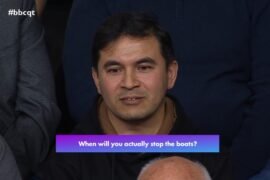
How the BBC conspired with open border activists to rig Question Time and ambush Reform

How the BBC conspired with open border activists to rig Question Time and ambush Reform

SMALL-boat migrants to the UK who confronted Reform UK’s Zia Yusuf on a BBC1 Question Time immigration special late last year were placed there by pro-immigration campaigners.

That is the devastating central finding of Daily Telegraph investigation: the Corporation’s flagship current affairs programme, which is supposed to reflect public opinion, was rigged.

In the audience were two asylum seekers who vociferously challenged Yusuf, then Reform’s policy chief. With the BBC’s knowledge, they had been coached by IMIX, a campaigning charity which boasts that its mission is to welcome immigrants and build support for migration. One read a prepared statement from his phone.

Also with the BBC’s knowledge, IMIX’s chief executive, Jenni Regan, was in the audience and was selected to speak against reducing immigration. The charity later described the programme as an opportunity to ‘test some of our messaging directly’ on what it calls the ‘mixed middle’ or ‘persuadable’ public.

Yusuf claimed in the programme aftermath that he had been crudely ambushed. More than 1,000 viewers complained. The Daily Telegraph has now shown that the essence of his complaint was true.

The BBC’s own fortnightly complaints report later put the total at 1,379. It rejected the charge of bias in a single collective response, arguing that 20 audience members had contributed views from across the immigration debate and stressing that the two men had been granted refugee status and were living in Britain legally.

That response closed the complaints process without examining or disclosing the part played by IMIX in identifying and preparing the two men, or the fact that its chief executive had also been selected to speak. The Telegraph’s revelations therefore expose how incomplete and disingenuous the BBC’s answer to those 1,379 complainants was.

How deeply arrogant and complacent is that?

The full scale of the rigging remains unknown because the BBC has refused to reveal how the rest of the audience was chosen.

How many other members were recruited through campaign groups? How many were selected directly by the BBC because producers knew what they were likely to say? Which organisations were approached? How many people did each provide? Were any bodies campaigning for lower immigration given the same access? Who approved the final list, and according to what political hocus-pocus?

The BBC has refused to answer any of this.  Instead, it has issued the usual incantation that it contacted a range of organisations, sought different perspectives and retained ‘full editorial control’. That is supposed to end the matter. In fact, it makes the Corporation’s responsibility absolute.

Question Time in this context is fraudulent fiction: a managed political operation is being passed off as spontaneous public opinion.

Before anything the BBC says about the programme can be believed, it must publish its audience-selection procedures in full. It must identify every organisation involved in constructing the Dover audience, state how many potential participants each nominated, explain who selected those eventually admitted and disclose how producers supposedly ensured political balance.

It must also say whether this is normal Question Time practice. Until those questions are answered, nobody can know where the public audience ended and the BBC’s political construction began.

The treatment of Yusuf makes the episode more serious still. Reform is a major political force that could form the next government. Yusuf is one of its most senior figures and could hold high office if the party enters government. Yet the BBC conspired against him. That was an act of profound political disrespect.

I have personal experience of what Question Time was meant to be. Between 1983 and 1985, when I was BBC Television’s News and Current Affairs publicity officer, it was one of my programme responsibilities. I came to know well its formidable founder editor Barbara Maxwell. Its authority rested on the principle that politicians were being tested live for the first time on British television before a genuine public audience. I suspect she would be turning in her grave at what the programme has now become.

The most alarming aspect of the Dover ambush is that the BBC has every reason to expect to get away with their manipulation.

Immunity from such scrutiny has been hard-wired into the regulatory system since Ofcom assumed responsibility for regulating the BBC at the beginning of 2017 when its current Charter took effect.

News-watch’s first Question Time complaint in 2017 under that regime concerned the programme’s treatment of Brexit. Viewer Gavin Hunt had painstakingly tracked a complete season of 25 editions. He found that 22 panels had Remain majorities, eight had four Remain supporters to one Leave supporter and only two had Leave majorities.

It was precisely the sort of systematic evidence needed to test whether the programme’s selection procedures were producing sustained political imbalance. With wearing predictability, the BBC Executive Complaints Unit rejected it.

News-watch referred the case to Ofcom, the supposedly independent final arbiter. Ofcom refused to examine the 25 programmes, claiming that doing so would not be ‘proportionate’. It selected only two. Which clown at the regulator authorised that? One was a special edition following the Manchester Arena bombing and contained no meaningful Brexit discussion. The whole season’s evidence was therefore reduced to one relevant programme. The edition chosen had a panel overwhelmingly composed of people who had supported Remain. Ofcom nevertheless decided that the MP Damian Green had represented Leave ‘with vigour’. Green had campaigned for Remain. But because he was a Conservative minister defending the Government’s obligation to implement the referendum result, Ofcom converted him into a Brexit advocate. It was regulatory sophistry. Accepting that a democratic result had to be implemented was not the same as believing in Brexit or presenting the positive case for it.

Most significantly, Ofcom declared that going forward, it had no role in deciding how Question Time selected its panels or audiences. Those were editorial matters for the BBC. That was a huge get-out-of-jail-free card. It meant that BBC could select its audiences behind closed doors and it confirmed that the Corporation remained judge and jury in its own cause. Ofcom did not give a damn.

The Dover immigration special is where that system has led. A pro-immigration campaigning charity helped place and prepare two small-boat migrants to challenge Reform’s policy chief. Its chief executive was also selected to speak. The charity regarded the appearance as an opportunity to test its messaging. The BBC disclosed none of this and still refuses to explain how the rest of the audience was constructed.

It plainly expects the familiar formula to work again: issue a vague assurance about editorial control, disclose nothing of substance and wait for Ofcom to conclude that audience selection is a matter for the BBC.

That cannot be allowed to happen. The BBC must publish the complete details of the Dover programme and reveal how often campaigning organisations have helped populate other Question Time audiences. Until it does, viewers should treat Question Time’s claim to represent public opinion with the deepest suspicion. The Dover programme was not an open public debate. It was a biased production whose flagrantly skewed casting decisions remain hidden from the people watching it.

BBC admits Brexit bias – then attacks the critics who exposed it

BBC admits Brexit bias – then attacks the critics who exposed it

FOR the first time in News-watch’s 27 years of monitoring the BBC, the Corporation has partially upheld a complaint about EU-Brexit coverage. ‘Partially’ is crucial in showing the contortionist nature of its accountability.

The BBC’s Executive Complaints Unit (ECU) accepted that flagship Radio 4 Today programme breached impartiality by presenting the case for closer alignment with the European Union without acknowledging the opposing argument for making fuller use of the freedoms provided by Brexit. But Fraser Steel, head of the ECU, rejected the greater part of the complaint by endorsing the gross bias underlying the programme.

When the Daily Telegraph reported the ruling on Friday and exposed that contradiction, the BBC did not address it. Instead, in its right of reply, it reverted to the stonewalling it usually adopts when addressing complaints. It defended Steel and dismissed criticism of his reasoning. Move along, folks, nothing to see.

The News-watch complaint was based on the Today programme’s handling of Governor of the Bank of England Andrew Bailey’s Mansion House Speech on November 15, 2024. He argued that Brexit was one of the main reasons the British economy was not performing as well as it could or should.

News-watch argued that the sequence constructed was totally biased in favour of Bailey’s anti-Brexit stance.

Katya Adler, the BBC’s Europe editor, reported that Bailey was ‘not alone in pointing the finger at Brexit’. She interviewed two contributors who broadly supported his analysis.

The first was Sir John Gieve, a former deputy governor of the Bank of England. He cited estimates suggesting Brexit would reduce GDP by between 4 and 6 per cent and described this as the consensus among experts. Yet he also conceded that measuring Brexit’s economic effects was ‘extremely difficult’ and that economic models were poor at measuring major shocks.

That should have prompted rigorous questioning. Britain’s economy had also been affected by covid, the war in Ukraine, energy prices, inflation, interest rates and domestic policy. Estimates of Brexit’s impact depend heavily upon counterfactual models comparing the real economy with a hypothetical Britain which remained in the EU.

Adler, however, did not explore further those uncertainties Instead, the discussion moved towards closer relations with Brussels.

The second contributor was Liam Byrne, Labour MP and chairman of the Commons Business and Trade Committee. He advocated reducing trading friction, aligning agrifood standards, considering a youth mobility agreement and developing closer economic relations with the EU.

In sum, Bailey supplied the diagnosis that Brexit had damaged Britain, Gieve reinforced it with economic estimates, and Byrne proposed remedies based on closer EU alignment.

The programme did not include a contributor who articulated the alternative case. No one argued that Britain might improve its prospects through regulatory freedom, independent trade policy or fuller use of powers returned from Brussels. Nor did the programme test whether poor post-Brexit government decisions should be treated as proof that Brexit itself had failed.

News-watch’s complaint, submitted in December 2024 and elevated to the ECU in March 2025, was not a crude demand for equal numbers of leave and remain supporters. It challenged the entire editorial construction: the premise, the guests, the questioning and the range of policy options listeners were allowed to hear.

The BBC took an astonishing 18 months to resolve it, issuing Steel’s final ruling on June 4.

Steel rejected several central elements. He said Adler had merely summarised Bailey’s speech, and that the shared outlook of the two guests was not itself a breach. Most importantly, he found no failure of impartiality in their ‘shared assumption’ that Bailey’s diagnosis was broadly correct. He said this reflected the predominant view among economists and that he had found no significant body of opinion suggesting Brexit’s effects had been positive or neutral.

That was the basis on which most of the complaint was rejected.

Steel nevertheless ruled that the programme did breach impartiality when discussing the remedy. It had assumed that the answer lay in closer EU alignment without acknowledging the alternative argument that Britain could improve its performance by exploiting opportunities outside the EU and its regulatory system.

He concluded that the competing arguments were so clearly controversial that the item should at least have acknowledged the alternative case. The complaint was therefore partially upheld, and Steel apologised on behalf of the BBC.

This was a significant concession: the ECU accepted that a flagship BBC programme had discussed a central question about Britain’s economic future from only one side.

But Steel separated the diagnosis from the remedy. He accepted that the remedy required an alternative perspective while ruling that the diagnosis of Brexit damage did not.

That distinction is hard to sustain. The programme began with the proposition that Brexit was a major cause of weak performance, reinforced it with two sympathetic contributors, and moved to closer alignment. Once Bailey’s analysis was treated as settled, the direction was predetermined.

Steel’s invocation of an economic consensus did not answer this objection. If anything, it reinforced it. A predominant view is entitled to coverage, but it does not turn model-based estimates into directly observable fact or remove the BBC’s duty to test consequential claims.

Nor does it prove that there is no serious argument about the scale and causes of the effects, the policies adopted since Brexit or the opportunities leaving the EU created. Gieve’s own warning that measurement was extremely difficult should have made the BBC more cautious, not less.

The Daily Telegraph rightly focused on this reasoning. News-watch was quoted as saying the complaints process had ‘bent over backwards’ to explain away the rest of the imbalance.

The BBC’s answer as reported in the Telegraph piece was revealing. A press office spokesman declared: ‘The BBC has no view on the economic impact of Brexit, and nothing in this finding suggests otherwise.’ But the spokesman immediately defended Steel by citing ‘the consensus among economists’ as a reason for rejecting that part of the complaint. The contradiction is obvious. The BBC said it has no view, yet relied upon one economic assessment to decide that Bailey’s diagnosis required no substantive challenge.

That is not neutrality. It is the treatment of one disputed view as the neutral baseline.

The BBC also defended Steel’s experience and the independence of the ECU. This was irrelevant. The criticism was not that Steel lacked experience or had been instructed what to conclude. It was that his reasoning was inconsistent and rested on assumptions which were themselves under challenge. Instead of confronting that criticism, the BBC invoked the credentials of its official and the status of its process. That is a text-book example of how an institutional confirmation-bias bubble protects itself. On Brexit, the negative interpretation is repeatedly treated as expert analysis, while the alternative is treated as political advocacy requiring special justification. The same culture then adjudicates complaints about the resulting output.

News-watch has spent 27 years documenting this process through about 70 detailed reports. The BBC has never properly engaged with that systemic evidence. Its complaints arrangements confine challenges to individual programmes or narrowly linked sequences, excluding evidence of recurring patterns across hundreds of broadcasts. In effect, the system inspects individual bricks while refusing to look at the wall.

That makes this partial upholding a painful climbdown for the Corporation. Is that why it took 18 months for the ECU to arrive at this ruling? The BBC has finally accepted with all the grace of a sulky child that a Brexit item was biased because it airbrushed out of the equation pro-Brexit opinion.

The ruling also exposes the deeper problem. Steel accepted the omission at the point of remedy while endorsing the assumption which drove the item from its opening sentence. When challenged, the BBC defended Steel and repeated the very consensus argument under dispute.

The BBC has finally partially admitted to News-watch Brexit bias. That is a landmark. Its reaction shows why it took 27 years to arrive there.

Hamas critic sacked, Hamas fans get a slap on the wrist at two-tier BBC

Hamas critic sacked, Hamas fans get a slap on the wrist at two-tier BBC

THE BBC insists that its journalism is impartial. According to a report in the Daily Telegraph , former local radio reporter Sean McGinty’s treatment by the Corporation suggests that instead, impartiality has become a crude instrument of institutional discipline, applied most ferociously against its own staff who do not conform to its worldview .

McGinty, 61, a former BBC Radio Lancashire presenter, was dismissed for gross misconduct after criticising the Corporation’s refusal to describe Hamas as terrorists following their savage massacre of Israelis on October 7, 2023. He also attacked the BBC’s use of casualty figures originating with Hamas and accused it of having a ‘fear of the word terrorist’.

The Telegraph reported that the sacking – confirmed in February this year after he appealed against an industrial tribunal ruling – seriously affected his mental health but it has since improved and he now wanted to speak up about his treatment by the Corporation.

His central point which led to his dismissal was a grave accusation. Hamas is a proscribed terrorist organisation in Britain. Its gunmen have for years murdered civilians, taken hostages and committed acts of calculated barbarity. McGinty lost his career for simply stating the obvious.

At almost exactly the same time, six BBC Arabic journalists were investigated over social media activity which appeared to justify or celebrate the October 7 attacks. None was dismissed. They were reportedly given advice and required to undergo impartiality and social media training.

That huge discrepancy in treatment is a question the BBC must answer. It is also the issue that the BBC press office response to the Telegraph conspicuously avoided.

The Corporation said simply that McGinty had been dismissed for gross misconduct and that an employment tribunal had rejected his claims. That may have established that the BBC probably adhered to the letter of employment law. But it had nothing to do with whether BBC acted consistently, fairly or impartially as a journalistic institution.

An employment tribunal is not an inquiry into the BBC’s editorial culture. It does not determine whether the Corporation applies different standards according to the political direction of an employee’s opinions. Nor does it show that the BBC’s underlying policy on Hamas was editorially sound. The tribunal’s ruling therefore cannot dispose of the central question: why did criticism of the BBC’s handling of a terrorist organisation attract dismissal, while apparent sympathy for the organisation’s atrocities did not?

The imbalance is startling.

Had McGinty praised or excused Hamas while colleagues were dismissed for objecting, the BBC would rightly have faced uproar. Yet because the disciplinary direction ran the other way, the Corporation appears to believe that invoking ‘gross misconduct’ and citing a tribunal judgment is sufficient.

It most certainly is not.

News-watch has spent 27 years exposing this same institutional reflex. The BBC rarely confronts evidence of bias on its merits. Instead, it retreats behind process, technical distinctions and the authority of its own internal machinery. The complaint is narrowed. The wider evidence is excluded. The critic’s language, motivation or status becomes the subject of scrutiny. The Corporation itself remains the judge and jury of whether the Corporation has behaved properly.

McGinty’s case is a particularly stark example because it concerns not only output, but the policing of opinion inside the BBC.

The message to employees is as subtle as a brick. Those who remain within the Corporation’s accepted ideological boundaries may expect mistakes or inflammatory comments to be treated as correctable lapses. Those who publicly challenge the editorial consensus risk being treated as threats to the BBC’s reputation.

McGinty himself compares his treatment to a dead sparrow nailed to a fence as a warning to the others. The image is brutal, but it captures the wider significance of the case. His dismissal sent the message of the grave possible consequences for any BBC employee who publicly questions the institution’s editorial orthodoxy.

That is deeply concerning because impartiality depends upon internal argument. A broadcaster claiming to serve the whole country ought to welcome journalists who test fashionable assumptions, challenge euphemistic language and ask whether leftist metropolitan editorial judgments make sense to audiences outside London.

Instead, McGinty describes a culture in which dissent is suppressed and managers confuse protection of the BBC’s reputation with protection of its prevailing worldview.

His account of how local radio operates is also revealing. He alleges that, before the 2016 referendum, a producer refused to allow a caller worried about immigration’s impact on public services to go on air because she was deemed ‘racist’. His allegation is wholly consistent with patterns repeatedly identified by News-watch: legitimate public concerns are too often interpreted through the leftist political and moral assumptions of BBC staff before they are permitted to reach the audience.

The BBC’s problem is not simply that it contains biased individuals. Every large organisation contains people with a multiplicity of opinions. The deeper problem with the BBC is that one variety of opinions has become entrenched. Those who share it may not even recognise it as political. They are locked in confirmation bias and firmly believe they are defending decency, accuracy and responsible journalism.

Views outside that consensus, however, are treated not as alternative judgments deserving fair examination, but as reputational hazards.

That helps explain the grotesque disparity at the heart of the McGinty affair. BBC Arabic journalists whose social media activity appeared to support or excuse Hamas could be regarded as having made errors requiring guidance. A loyal, hard-working, deeply conscientious local radio journalist who accused the BBC itself of failing to identify terrorism was treated as having placed himself beyond the pale.

That contrast tells us more about the BBC’s gross failure to understand the true nature of impartiality than any number of its blizzard of self-commissioned and self-justifying corporate reviews, managerial assurances or carefully drafted statements.