Question Time

How the BBC conspired with open border activists to rig Question Time and ambush Reform

How the BBC conspired with open border activists to rig Question Time and ambush Reform

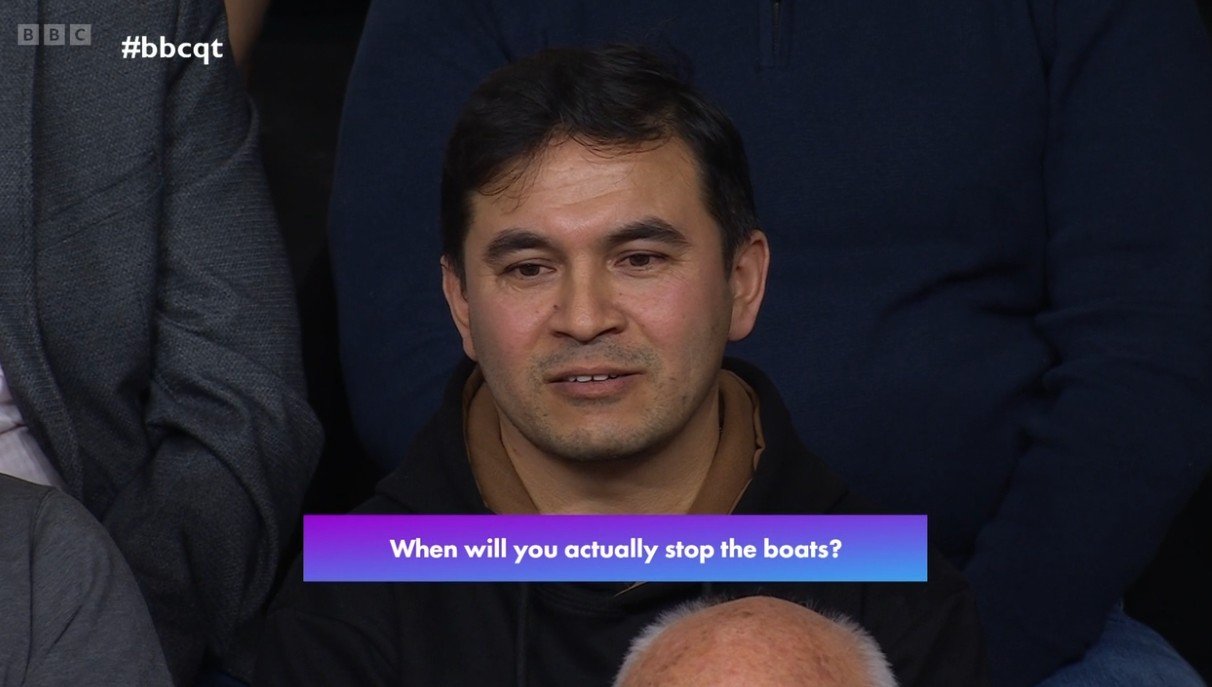
SMALL-boat migrants to the UK who confronted Reform UK’s Zia Yusuf on a BBC1 Question Time immigration special late last year were placed there by pro-immigration campaigners.

That is the devastating central finding of Daily Telegraph investigation: the Corporation’s flagship current affairs programme, which is supposed to reflect public opinion, was rigged.

In the audience were two asylum seekers who vociferously challenged Yusuf, then Reform’s policy chief. With the BBC’s knowledge, they had been coached by IMIX, a campaigning charity which boasts that its mission is to welcome immigrants and build support for migration. One read a prepared statement from his phone.

Also with the BBC’s knowledge, IMIX’s chief executive, Jenni Regan, was in the audience and was selected to speak against reducing immigration. The charity later described the programme as an opportunity to ‘test some of our messaging directly’ on what it calls the ‘mixed middle’ or ‘persuadable’ public.

Yusuf claimed in the programme aftermath that he had been crudely ambushed. More than 1,000 viewers complained. The Daily Telegraph has now shown that the essence of his complaint was true.

The BBC’s own fortnightly complaints report later put the total at 1,379. It rejected the charge of bias in a single collective response, arguing that 20 audience members had contributed views from across the immigration debate and stressing that the two men had been granted refugee status and were living in Britain legally.

That response closed the complaints process without examining or disclosing the part played by IMIX in identifying and preparing the two men, or the fact that its chief executive had also been selected to speak. The Telegraph’s revelations therefore expose how incomplete and disingenuous the BBC’s answer to those 1,379 complainants was.

How deeply arrogant and complacent is that?

The full scale of the rigging remains unknown because the BBC has refused to reveal how the rest of the audience was chosen.

How many other members were recruited through campaign groups? How many were selected directly by the BBC because producers knew what they were likely to say? Which organisations were approached? How many people did each provide? Were any bodies campaigning for lower immigration given the same access? Who approved the final list, and according to what political hocus-pocus?

The BBC has refused to answer any of this.  Instead, it has issued the usual incantation that it contacted a range of organisations, sought different perspectives and retained ‘full editorial control’. That is supposed to end the matter. In fact, it makes the Corporation’s responsibility absolute.

Question Time in this context is fraudulent fiction: a managed political operation is being passed off as spontaneous public opinion.

Before anything the BBC says about the programme can be believed, it must publish its audience-selection procedures in full. It must identify every organisation involved in constructing the Dover audience, state how many potential participants each nominated, explain who selected those eventually admitted and disclose how producers supposedly ensured political balance.

It must also say whether this is normal Question Time practice. Until those questions are answered, nobody can know where the public audience ended and the BBC’s political construction began.

The treatment of Yusuf makes the episode more serious still. Reform is a major political force that could form the next government. Yusuf is one of its most senior figures and could hold high office if the party enters government. Yet the BBC conspired against him. That was an act of profound political disrespect.

I have personal experience of what Question Time was meant to be. Between 1983 and 1985, when I was BBC Television’s News and Current Affairs publicity officer, it was one of my programme responsibilities. I came to know well its formidable founder editor Barbara Maxwell. Its authority rested on the principle that politicians were being tested live for the first time on British television before a genuine public audience. I suspect she would be turning in her grave at what the programme has now become.

The most alarming aspect of the Dover ambush is that the BBC has every reason to expect to get away with their manipulation.

Immunity from such scrutiny has been hard-wired into the regulatory system since Ofcom assumed responsibility for regulating the BBC at the beginning of 2017 when its current Charter took effect.

News-watch’s first Question Time complaint in 2017 under that regime concerned the programme’s treatment of Brexit. Viewer Gavin Hunt had painstakingly tracked a complete season of 25 editions. He found that 22 panels had Remain majorities, eight had four Remain supporters to one Leave supporter and only two had Leave majorities.

It was precisely the sort of systematic evidence needed to test whether the programme’s selection procedures were producing sustained political imbalance. With wearing predictability, the BBC Executive Complaints Unit rejected it.

News-watch referred the case to Ofcom, the supposedly independent final arbiter. Ofcom refused to examine the 25 programmes, claiming that doing so would not be ‘proportionate’. It selected only two. Which clown at the regulator authorised that? One was a special edition following the Manchester Arena bombing and contained no meaningful Brexit discussion. The whole season’s evidence was therefore reduced to one relevant programme. The edition chosen had a panel overwhelmingly composed of people who had supported Remain. Ofcom nevertheless decided that the MP Damian Green had represented Leave ‘with vigour’. Green had campaigned for Remain. But because he was a Conservative minister defending the Government’s obligation to implement the referendum result, Ofcom converted him into a Brexit advocate. It was regulatory sophistry. Accepting that a democratic result had to be implemented was not the same as believing in Brexit or presenting the positive case for it.

Most significantly, Ofcom declared that going forward, it had no role in deciding how Question Time selected its panels or audiences. Those were editorial matters for the BBC. That was a huge get-out-of-jail-free card. It meant that BBC could select its audiences behind closed doors and it confirmed that the Corporation remained judge and jury in its own cause. Ofcom did not give a damn.

The Dover immigration special is where that system has led. A pro-immigration campaigning charity helped place and prepare two small-boat migrants to challenge Reform’s policy chief. Its chief executive was also selected to speak. The charity regarded the appearance as an opportunity to test its messaging. The BBC disclosed none of this and still refuses to explain how the rest of the audience was constructed.

It plainly expects the familiar formula to work again: issue a vague assurance about editorial control, disclose nothing of substance and wait for Ofcom to conclude that audience selection is a matter for the BBC.

That cannot be allowed to happen. The BBC must publish the complete details of the Dover programme and reveal how often campaigning organisations have helped populate other Question Time audiences. Until it does, viewers should treat Question Time’s claim to represent public opinion with the deepest suspicion. The Dover programme was not an open public debate. It was a biased production whose flagrantly skewed casting decisions remain hidden from the people watching it.

Time for a re-think on BBC1 Question Time?
Time for a re-think on BBC1 Question Time?

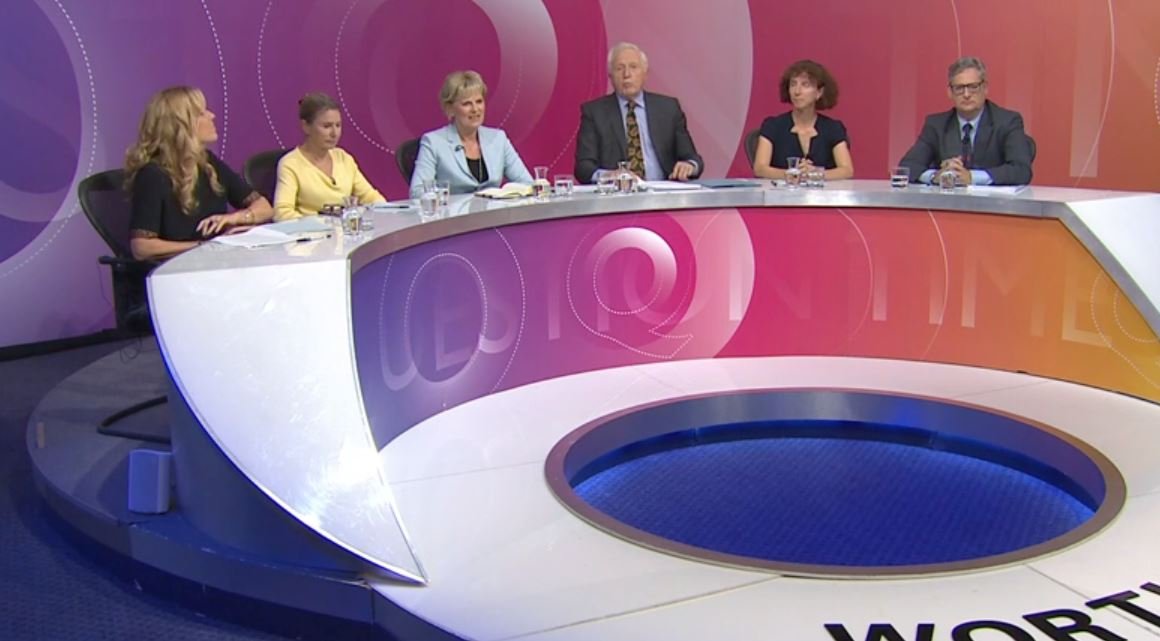
There have been 1,369 editions of BBC1’s Question Time since its launch under Sir Robin Day in September 1979, and it has an estimated weekly audience of 2.4m in its 10.40pm slot on Thursdays.

David Dimbleby has announced he is leaving the show after 25 years in the chair, following 10 years by Sir Robin Day (1979-89) and four from Peter Sissons (89-93) – so what next?

Already, there is a list of potential successors, ranging from Kirsty Wark to Victoria Derbyshire and Huw Edwards. But almost certainly, it won’t be a man.  This is now the era of BBC ‘diversity’/feminism quota box-ticking, outlined here,  and no woman has yet been the show’s permanent host – though back in the mid-1980s, Nationwide host Sue Lawley deputised regularly for Sir Sir Robin Day.

Already, despite this, the Conservative Commons equalities committee chair Maria Miller has stepped into the frame, warning the BBC that it must appoint a woman.

Woe betide the BBC, therefore, if it appoints a man. And now that it is in the full grip of the ‘quota’ agenda, can the Corporation risk appointing any more a white woman to the role?

This is an organisation where the head of comedy, Shane Williams, said this week at a programme launch that Monty Python – one of the greatest creative hits in television history – would not now be made by the BBC because it was conceived by and starred white Oxbridge graduates.

On that basis, there must only be a handful of candidates for Question Time. Step forward Today presenter Mishal Husain and Samira Ahmed, who hosts the BBC News Channel’s complaints programme Newswatch, after cutting her television teeth on Channel 4 News. So certain is Ms Ahmed that she is in with a shout that she has self-declared her candidacy on Twitter.

Ms Husain has already occupied the Question Time chair briefly, during the debates leading up to the 2017 General Election.  Her debut, as is reported here,  did not go well. The audience was ram-full of raucous supporters of Jeremy Corbyn and Ms Husain had great difficulty controlling proceedings.  She was also loudly heckled – and almost drowned out – when she asked the Labour leader how he would pay for his (uncosted) child care policies.

The BBC thus has a serious dilemma of its own making in its hands. Quotas are a serious bind and indeed are likely to stifle creativity and excellence in programme-making.

In reality,however, women have been centre stage in the production of Question Time since its inception.  The first editor was a formidable feminist, Barbara Maxwell, called by Sir Robin ‘the flame haired temptress’. Her reign at the helm lasted 14 years.

The story of the pressures faced by Sir Robin from Ms Maxwelll is told in Peter  Sissons in his autobiography and summarised here.  From the outset she worked to ensure that women panellists were a regular part of the show, often irrespective – Sir Robin believed – of whether they had enough experience to be able  to deliver under the unique pressures the show generated.

When Peter Sissons – lured to the BBC in 1989 from ITN to be Sir Robin’s successor – took over the show, Ms Maxwell made it clear to him that the female quota system must continue. When Sissons objected, she made his life in the chair as awkward and uncomfortable as possible for him by the choice of sometimes unsuitable and incompetent female panellists.

Sissons says he left the show four years later when the BBC decided Question Time would be put out to independent production. The team appointed was all-female and – Sissons alleged – intensified the pressure on him.

Sue Lawley was then lined up as his successor, but ruled herself out because the BBC insisted that there must be a three-legged audition process involving David Dimbleby, Jeremy Paxman and Ms Lawley. Although she was the clear favourite, Ms Lawley refused to take part because, it is claimed, she thought as an established BBC presenter, it was beneath her, so Dimbleby was appointed.

The point of all this?   Despite its long history of female involvement and the encouragement of participation by  ‘minorities’, Question Time seems now destined to have a host who will be chosen on the basis of quota-related box-ticking rather than his or her capacity to perform in a particularly tough hot seat.

Another issue here is whether the programme is actually past its sell-by date. The format of voters confronting politicians  was innovative in 1989 but almost 40 years on it has become hackneyed and formulaic. As is argued here, it has arguably become a platform for platitudes, a performance vehicle for those who can blather best. Rather than illuminating the political process, it generates mainly obfuscation.

Not only that, as the Institute of Economic Affairs argues here, it has become deeply biased, especially since the EU referendum, with panels heavily weighted towards the Remain side.

The BBC has a programme budget of billions. It is high time it started to use it generate innovative news and current affairs programmes rather than hobbling along with the tired relics of another age.