Ofcom

Charter Renewal Review Fails to Tackle BBC Bias

Charter Renewal Review Fails to Tackle BBC Bias

Former deputy governor of the Bank of England Sir David Clementi’s review of BBC governance as part of BBC Charter renewal looks impressive at first glance – but he has badly misunderstood what is required.

What he proposes will leave the Corporation entrenched at the heart of the broadcasting establishment and almost impervious to real change; even worse, the proposals will do nothing to attack endemic BBC bias.

It’s an elegantly worded, absorbing read, and contains some good logistical proposals for improving the Corporation’s internal administration, including the creation of a beefed up BBC executive board, with a full-time chairman who would be more senior in the pecking order than the director-general.

That could provide a much-needed counterweight to arguably the most powerful figure in world media; Lord Hall, the current incumbent, is – almost uniquely in big media organisations – effectively both chief executive and editor-in-chief.

Sir David has also recommended that, as widely predicted, the current Trustees should be abolished. Bravo. But here, his good ideas ran out because his solution is that the BBC should then be placed under Ofcom.

Disaster! The malaise of the BBC is principally that it is run by broadcasting establishment figures with no desire to think radically or independently – and Ofcom is no different. It is a quango, peopled by liberal left quangocrats cast from exactly the same mould as the BBC Trustees.

For example, Ofcom’s current chairman, is Dame Patricia Hodgson, who spent a quarter of a century as a BBC producer, strategy executive, and a BBC Trustee. She has never worked outside the public sector.

All that will happen as a result of Sir David’s proposals is that the Corporation will be absorbed into the overall broadcasting establishment. There might be a few more challenges to some of its more nakedly commercial activities – such as the dominance of the internet – but the chances of radical reform, for example of the licence fee, will vanish, because Ofcom overwhelmingly favours the status quo. To them, it’s an article of faith that taxpayer funding is the highest good.

There’s a further vital area that Sir David missed altogether – so glaring an omission that it negates and renders virtually useless the whole exercise.

The rot in the BBC is not as Sir David appears to think, primarily about management systems. It is that almost every aspect of the Corporation’s output is biased – and the staff are so much in a liberal left bubble that they are blind to it.

That’s because the BBC is its own judge and jury in the handling of complaints and over the years, has constructed a hugely complex complaints procedure that is designed primarily for one purpose: to protect the Corporation and its journalists. In the same vein, editorial guidelines have been fashioned around the false yardstick of ‘due impartiality’, a concept that allows BBC editors and executives to interpret balance in areas such as climate change and immigration entirely on the Corporation’s own terms.

The upshot is that most complaints are rejected on highly cavalier grounds, and the BBC is totally out of touch with its audiences. It despises ‘populism’ in all its forms – and especially the Brexit variety.

Over the years, the Corporation has become cumulatively more biased in line with the prevailing liberal left ideology that forms the stifling orthodoxy at the heart of British public life. Those who work at the BBC would never acknowledge this in a thousand years; but to any outside observer of a different mindset it is blindingly obvious.

Against this background, Sir David’s proposal is that complaints are still handled in the first instance almost exactly as before by the BBC itself and those focused on impartiality that are not resolved at that level will be passed on to Ofcom’s content board. He glibly concludes that this will hold the BBC ‘more publicly to account’ – but he’s badly wrong.

His ‘Broadcaster First’ internal complaints handling approach will solve nothing. The ‘unitary executive board’ will go native and like the boards of all public sector organisations, their primary drive will be to defend themselves against outside criticism.

Nothing will change about the editorial guidelines, a grotesque creation that allows BBC producers, executives and journalists to get away with blue murder in the name of ‘editorial judgment’.

There is no insistence on regular, robust assessments of content, only a vague requirement that the same sort of (biased) impartiality reviews that the Trustees have been trotting out for years continue.

Even worse is Sir David’s suggestion that Ofcom becomes the final court of appeal. Ofcom’s content board – which deals with impartiality issues – is chaired by Bill Emmott, a fanatical Europhile whose current main objective is to spread propaganda on a massive scale warning that Brexit would spell disaster for the UK.

Bizarrely, when this was pointed out in a previous TCW and News-watch blog, Ofcom’s response was to acknowledge that this was a potential problem. A spokesmen said Emmott would be forced to stand down when any matters connected to the EU were discussed.

But that would not help either, because as the same TCW post also pointed out, nearly every other member of the board has cosy links to the BBC and has spent considerable parts of their career in the BBC orbit. Thus, the handling by Ofocm of BBC complaints will not make one iota of difference to the current regime.

Culture secretary John Whittingdale told an audience of the broadcasting establishment after he received Sir David’s report that he was impressed by it. This TCW blog last year warned that the BBC consultation that he ordered could easily become an empty exercise – that David Cameron wanted the BBC to remain unreformed so that it would help him win the referendum. If Whittingdale adopts the Clementi report, there will be no change. ‘Biased Broadcasting Corporation’ will become a fully accurate description of our most powerful broadcast institution and be set in stone for another generation.

Photo by Matt From London

Commons media select committee misses the elephant in the room
Commons media select committee misses the elephant in the room

The Commons Culture, Media and Sport select committee has spent six months considering reform of the BBC in connection with the imminent renewal of its Royal Charter.

Its report – published last week with little fanfare – contains some half-decent proposals, such as abolishing the current Trustees and replacing them with a regulatory Board with real teeth, including checks on the currently unfettered powers of the Director General.

That said, the strength of such a body would depend on the appointment of members with genuine independence and a real desire to make sure the Corporation is properly impartial and provides distinctive programmes that justify the £3.7 billion public funding.

And the reality of British public life now is that taxpayer-funded bodies are staffed and run by individuals who are to a man and woman followers of liberal-left, right-on ideology. Nothing the Conservatives have done over the past six years has changed this one iota; if anything David Cameron has made things worse.

What is being recommended, therefore, is likely to lead to more of the same: an expensive and fruitless exercise in re-arranging the deck-chairs.

In one fundamental respect, too, the culture select committee might never have bothered with their inquiry. They have totally botched their approach to complaints handling. What they propose in this vital arena will make matters worse, not better.

The rot at the heart of the Corporation is that every aspect of its output is locked in liberal-left thinking. The staff are virtually all so like-minded that they incapable of seeing it. As a result, the BBC is on an unrelenting, no-holds-barred crusade to ram down our throats the importance of the EU, multi-culturalism, feminism and a whole lot more.

This is massively obvious to anyone who listens or watches. But the BBC, from the Trustees downwards, deny it, and they justify their stance using bizarre rules of ‘due impartiality’ which allow Corporation executives and editors to interpret balance entirely on their own terms.

The current complaints-handling system is a department of the BBC. The vast majority of what they receive is rejected. It defies belief that the culture committee have recommended this continues in its present form.

The only proposal for change is in dealing with complex complaints that are currently pushed upstairs to a unit of the Trustees, the Editorial Standards Committee. This is chaired by trustee Richard Ayre, who worked at the BBC for 30 years. A key lieutenant is Mark Damazer, a former controller of Radio 4 who made it the temple of right-on orthodoxy that it has become.

The culture committee has accepted the blindingly obvious, that this is the equivalent of having foxes in charge of the hen house, but their solution defies belief. They propose that responsibility is passed over to the content board of Ofcom, the body which regulates commercial broadcasting.

How can this improve things? – if anything, it will make matters worse. For starters, the Board is chaired by European Union fanatic Bill Emmott, who is so determined to prevent Brexit that he makes propaganda films showing the nasty outcomes that he believes will inevitably occur if the British electorate has the temerity to disagree with him. Ofcom itself is so worried about his fanaticism that they can’t trust him; they have stated that he will take no part in discussions about anything to do with the EU.

Scratch the surface, and it also emerges that almost every member of the Ofcom content board has worked in some way for the BBC. This TCW item observed:

‘What makes Emmott’s appointment so utterly damaging is that the rest of the Ofcom content board – in step with Quango Land generally, are like minds and like spirits; right-on ‘liberals’ to the core. The full list of 10 is here. What leaps out from their CVs is that all but two have worked for significant parts of their careers at the BBC. They write papers about how wonderful and important the BBC is. Many are closely linked to a BBC-favoured propaganda organisation called the (Reuters) Oxford Institute of the Media – which last November held a seminar about ensuring ‘fair’ coverage of the EU. Guess who chaired it? Bill Emmott!

One of the two content board members who has not worked at the BBC is Dr Zahera Harb, who began her career in journalism in the Lebanon, and is now a board member of the worthy-sounding Ethical Journalism Network. Don’t be deceived by such Orwellian double-speak. Its main concerns include attacking the ‘hate speech’ of Donald Trump and ensuring that the Palestinian Authority – along with immigration generally – gets better coverage in the media.’

And there we have it. The culture select committee’s proposal can only be described as bonkers. It is also a dereliction of duty. Their report only mentions ‘complaints’ 13 times, contains no discussion about the shortcomings of the current system, and no suggestion that they looked at alternatives.

What they propose won’t make a whit of difference to the BBC’s output – if anything, it will reinforce the already blatant bias because in future, editors and senior management will claim they are ‘independently’ monitored.

What’s doubly concerning is that no-one in the media has seen the need to comment on this. Charter renewal is a once in a decade opportunity to reform the BBC. It’s now clear that MPs aren’t prepared to tackle – or worse, don’t understand – what is required to halt the unrelenting stream of propaganda that is poisoning our culture, our civic life and our politics.


Photo by Mike Knell

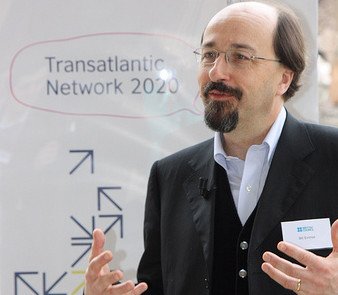
Ofcom: Europhile content board head Bill Emmott ‘will not rule on EU issues’
Ofcom: Europhile content board head Bill Emmott ‘will not rule on EU issues’

This is a guest posting from Craig Byers of the Is the BBC Biased? website.

Further to an earlier post
 
This is what that Ofcom statement says:

“Any conflicts of interest involving non-executive Board members are managed appropriately and Bill Emmott would not be involved in discussions or decisions related to the EU referendum.”

Isn’t that extraordinary?
For starters, they’ve clearly conceded David’s point that Mr Emmott’s appointment is problematic and, even more strikingly, they’ve shown themselves to have absolutely no confidence in the poor man’s capacity to behave in an impartial fashion in his new job on matters related to the EU referendum!
So, if what Ofcom are saying is true, Mr Emmott will surely have to leave the room or keep his mouth firmly shut every time matters relating to the EU referendum are raised?
Given that he’s supposed to be chairing those meetings, that isn’t exactly going to be an ideal situation for his fellow board members, is it?
Especially as Ofcom’s Content Board is likely to have quite a lot of discussions and make a lot of decisions on matters of related to the EU referendum over the coming months (or years).

Photo by UK in Italy