featured

BBC passes the buck over pro-EU website ads

BBC passes the buck over pro-EU website ads

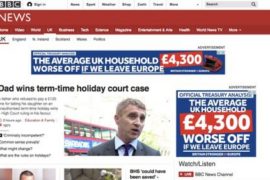
The eagle-eyed people over at Heat Street website noticed at the weekend that the BBC overseas website was running very prominent ‘remain’ banner ads, targeted at the 2 million ex pats in Europe, from the Britain Stronger in Europe group. They contained the highly misleading Project Fear message from Chancellor George Osborne that exiting the EU would cost every British family £4,300 a year – a claim that BBC home editor Mark Easton was busy debunking on the Today programme as the ads ran. The BBC took the ads down as soon as they were challenged about them by Heat Street. A BBC spokesman said they had been run ’in error’.  The statement in full was:

“This advert appeared outside the UK as the result of a third party error and was blocked as soon as we were alerted to it. We are investigating how this happened and we are taking steps to prevent this happening in the future.”

There was no further information, leaving unanswered how long the ads ran, how many page impressions they generated, and thus the extent of their overall impact. And it also remains a mystery how they ever saw the light of day. Surprise, surprise, the BBC slipped up in exactly the direction that its editorial output so strongly favours. Important here is the background. BBC services in overseas areas (primarily BBC World News) are allowed to take ads, and they raise substantial revenues, a total of £72m from around the world.

This being the BBC, however, the precise information on revenue is not available. Efforts in the past have been made to get at the exact figure through freedom of information requests, but the Corporation has resisted on grounds of ‘commercial sensitivity’. The only information in the public domain is that around £20m of revenues was generated by relevant European operations in 2011.  The proportion of that from website advertising, as opposed to on television output, would almost certainly, of course, have been relatively small, but nevertheless significant.

The second important point, this being the BBC, is that advertising and sponsorship is regulated by a 28-page publication called Advertising and Sponsorship Guidelines for Commercial Services, last updated in 2015.  One look at it makes it very clear that the appearance of the BSE ad was a jaw-dropping breach of the codes. Why? Well first of all, the main purpose is to ban very firmly numerous categories of commercials and to emphasise that any transgressions will be viewed very seriously.   Paragraph 1.4 says (in bold red):

Any proposal to step outside these guidelines must be editorially justified. It must be discussed and agreed in advance with a senior editorial figure. BBC Director Editorial Policy and Standards must also be consulted.

It goes on (2.3):

Advertising must not jeopardise the good reputation of the BBC or the value of the BBC Brand. It should: a) be suitable for the target audience; b) meet consumer expectations of the BBC brand; c) not bring the BBC into disrepute d) not give rise to doubts about the editorial integrity and independence or impartiality of the BBC.

And 2.9 is this:

Advertisements in the following categories must be approved by a senior editorial figure before they can be accepted for broadcast or publication: a) political advertising (on services where this is allowed); b) advertising by governments and government agencies (except tourism boards and trade or investment boards); c) advertising by lobby groups; d) advertising for infant formula or baby milk; e) advertising for any product or service which shares a name or trademark with a prohibited product or service, sometimes referred to as ‘Surrogate advertising’.

And then there is 2.13 (also in red):

Any advertisements that deal with a controversial issue of public policy, or which raise doubts about the BBC’s editorial integrity, must be referred to a senior editorial figure.

Every page is filled with similarly strong warnings and prescription. What this boils down to is that whatever happened over the BSE advert, it was a major breach of the advertising code and a clear failure of management procedures at a particularly sensitive period when the EU referendum was underway. Almost certainly, there was also a breach of the BBC’s (separate) specially-devised EU referendum coverage guidelines.

The BBC blamed a ‘third party error’ for the breach. But how on earth was supervision allowed to be so lax during the referendum campaign?  This was a gaff on a gargantuan scale. To blame a third party when the codes make it clear that decisions in this arena are of central importance to the reputation of the BBC is a total disgrace. But, then, at the very top (the BBC Executive Board) has got extensive form in blaming the wrong parties for its own mistakes.

Finally, an issue here is that it is impossible to gauge the likely impact of this breach on the referendum. How many ex pats and British holidaymakers did it actually reach? All the signs are that the poll remains on a knife-edge and overseas votes could well be crucial in determining the outcome. Tellingly, the ‘error’ was in favour of the pro-EU side, in line with much of the BBC’s other referendum output.

image: Peter Thompson, Heat Street


Brexit the Movie –  a perspective not on the BBC

Brexit the Movie – a perspective not on the BBC

This month marks the 17th anniversary of tracking by News-watch of the BBC’s EU-related output. The first survey was commissioned by a cross-party group of peers who were concerned that the case against the EU was not being aired by the BBC. It covered the build-up to the European Parliamentary elections on June 10, 1999.

The findings can still be read here. Key points relating to BBC bias are eerily familiar. They included bias by omission: election-related items on BBC television added to only 2.5% of airtime. Jeremy Paxman on Newsnight described the voters’ reaction to the poll as an ‘outbreak of narcolepsy’.  In the event, only 24% of the electorate voted, which still stands as the UK record lowest turnout in a national election.

Other points in the report were the virtual ignoring of the infant Ukip, despite the fact it came fourth,  attracted 700,000 (7%) of the votes cast and won three seats; a totally-predictable crude comparison of Ukip to the BNP in the sole interview featuring the party; a heavy and disproportionate focus on the breakaway Pro-Euro Conservative Party, which despite all the publicity, polled only 140,000 (1.4%) of the total turnout; a constant search for ‘Tory-splits’, even though – Michael Heseltine apart – the evidence seemed to be that William Hague’s party was remarkably united on EU policy; and virtually no exploration of either the overall Labour approach or potential splits within the party over the euro.

All of which brings Brexit the Movie – which, from today will have a permanent, prominent place on this site –  neatly into focus. For those of you who have not yet heard of it, this 71-minute feature by Martin Durkin – which was partially crowd-funded –  is a must-see. It’s a total revelation because it is a first: it straightforwardly and vigorously presents the ‘out’ case.

In Durkin’s estimation, negatives about the EU include that there are a staggering 10,000 European Union employees paid more than David Cameron; that Switzerland – despite being outside the EU – is one of the wealthiest countries in the world, with earnings double the average in the UK, and unemployment far lower; that the EU ‘Parliament’ is the only body with that name in the world which has zero powers to propose legislation; that although the EU claims to be a promoter of trade via the ‘single market’ , the reality is that for most of its history it has been a repressive force against the free movement of goods; and that far from promoting harmony, the fundamentally undemocratic structures of the EU are promoting unprecedented frustration and triggering the rise of extremist parties of both left and right.

This is a perspective and a range of information that News-watch monitoring shows beyond doubt that the BBC has never presented in a coherent form. Of course the BBC, it will probably argue, is not in the business of producing such material.  But why not? Last year, the Corporation commissioned and broadcast with great fanfare The Great European Disaster Movie, which showed at length the chaos and panic the makers claimed would ensue, if, God forbid, the UK exited the EU.

That film was made by former Economist editor Bill Emmott, a self-declared EU-fanatic, who has a set up his own ‘charity’ (with Richard Sambrook, a former Director of BBC News) to promote such propaganda. The BBC was so keen on his film project that it applied for (and obtained)  EU funding so that it could be translated into as many languages as possible; the fruit of their efforts is that screenings are due in Geneva, Bologna, Cardiff University and Bucharest over the next month.

Continuing monitoring by News-watch during the referendum campaign shows that the BBC is at last – for the first time –  airing some detailed elements of the Brexit case. But at best this effort can only be described as begrudging and half-hearted. Craig Byers, for example , of the Is the BBC Biased? site has shown this weekend that  since April 14, the BBC1 News at Six’s coverage of EU-referendum related headlines have led with ‘remain’ headlines 14 times, compared to the ‘out’ side three times.

In the same vein, News-watch analysis of the May 11 and 12 News at 10 coverage of the Mark Carney, Sir John Major and Christine Lagarde interventions into the referendum debate was heavily skewed towards the ‘remain’ case. And other long-term investigations have shown that Newsnight, World Tonight and The World This Weekend coverage of referendum matters is strongly similarly imbalanced.

What is certain is that – although it is impossible to frame a definitive verdict at this stage about BBC coverage – the facts assembled by Durkin have never been presented in such a way by the Corporation. Don’t hold your breath that they will. Watch Brexit the Movie instead.

Craig Byers:  Here is the news. BBC bias revealed hour by hour

Craig Byers: Here is the news. BBC bias revealed hour by hour

Thursday was ‘the big day’ at the BBC, and yesterday morning’s Today was all over Mr Whittingdale’s Charter Review report.

Did the BBC treat the story impartially?

Well, on Today there was Lib Dem peer Lord Lester QC sticking up for the BBC. And Labour’s Tessa Jowell sticking up for the BBC. And former BBC, Sky and ITV employee Professor Lis Howell half-criticising and half-sticking up for the BBC. And BBC presenter Nick Robinson not exactly firing, in ‘devil’s advocate’-style, on all impartial cylinders either.

They did have the SNP’s John Nicholson, for ‘balance’ though, demanding a Scottish News at Six – and getting a rough ride from Mishal Husain in the process. ‘Who wants that?’ was Mishal’s basic point. (A fair point, probably).

Impartial? Hardly.

And then came  The World at One on BBC Radio 4. And that was even worse.

After a short review of events in Parliament came a discussion between the BBC’s Martha Kearney and Steve Hewlett of the Guardian/BBC Radio 4’s Media Show, which suggested the Charter review wasn’t as bad as the BBC and its supporters feared, but that there are still issues of concern for them.

Then came a much shorter interview with Peter Bone MP, a BBC critic. It was the ‘balancing item’ -even though it lasted barely more more than a minute (the shortest interview by far).

Astonishingly, Martha forcefully stopped him in his tracks as as soon as he raised what he described as his “main concern”: BBC pro-EU bias. Martha clearly wasn’t going there for anything in the world. Realising that, Mr Bone just laughed.

Then came Jesse Norman MP saying that the government’s plan is great and the BBC is great.

Then came Labour-supporting former BBC Trust boss Sir Michael Lyons (not that Martha even hinted at such a thing) attacking the Government for going too far but saying that there is a problem with BBC bias: bias against Labour’s Jeremy Corbyn. A somewhat-startled-sounding Martha Kearney not only didn’t cut him off when he raised it (in contrast to how she treated Peter Bone when he tried to air his concerns about pro-EU BBC bias) but actually went on to press his pro-Labour ‘BBC bias’ point with Lord Hall.

And Lord Hall was the big WATO interview.

He didn’t agree with Sir Michael about the BBC’s anti-Corbyn bias (you won’t be surprised to hear), saying that the BBC is impartial (you also won’t be surprised to hear) and that the BBC brings “light to controversy”.

Lord Hall sounded pleased with what the Government has announced. The BBC’s Martha (gently) pressed him largely from a pro-BBC, Wolf Hall director Peter Kosminsky-type standpoint rather than an anti-BBC Andrew Bridgen MP-type standpoint.

And that was that: Lots of pro-BBC types having their say, plus (very briefly) Peter Bone.

Impartial? Hardly.

Meanwhile over on BBC One’s News at One bulletin we got more of the same, plus three items on the EU referendum: Mark Carney of the Bank of England’s dire warnings of the economic dangers of voting to leave the EU came first. A little later came the Vote Leave/ITV spat over whether Nigel Farage should be involved in a TV debate with David Cameron. And finally, immediately before the sports news (i.e. as the last ‘serious’ news item), came the news that the ONS has finally conceded that immigration from the EU has been massively under-represented in the government’s official figures (not that the short BBC news item put it like that) – a point that many people have been saying might well give a huge boost to the Leave campaign.

So why did BBC One choose to ‘bury’ that story as a very short new item near the end of its lunch time news bulletin?

Wasn’t that Peter Bone’s point being proved?

Impartial? Hardly.

And then came BBC’s News at Six.

BBC One’s News at Six began with another pro-Leave point: Bank of England governor Mark Carney’s dire warnings about a vote to leave the EU:

A warning from the Bank of England: Leaving the EU could trigger a recession.

The bulletin’s reporting was ‘impartial’ in the BBC sense, in that:

  • (a) the bulletin kept using words like “stark” and “strong” to describe the governor’s comments.
  • (b) the BBC’s economics editor Kamal Ahmed, after laying out Mr Carney’s anti-Brexit case in detail, said that “many economists agree with the Bank’s gloomy prognosis” and then featured one such economist doing just that…
  • ‘…balanced’ by (c) a clip of Norman Lamont saying, very briefly, that Mr Carney is wrong…
  • and then (d) BBC political reporter Alex Forsyth setting the context by saying that Mr Carney’s intervention is “undoubtedly a boost” to the Remain campaign as Mr Carney is “a senior, credible figure once again warning in no uncertain terms of the economic risks of leaving.

ITV’s early evening news bulletin also led with that pro-Leave point and, like Kamal Ahmed, ITV’s deputy political editor Chris Ship also laid out the governor’s concerns in some detail.

Unlike the BBC, however, Chris Ship also said “the truth is” that the economic forecasts aren’t great at the moment whichever way we vote, and his ‘talking heads’ included two people who disagreed with Mr. Carney: John Redwood and Wetherspoons boss Tim Martin – both making substantive points against the BoE governor.

ITV struck me as taking its ‘impartiality’ responsibilities far more seriously than the BBC there. The BBC felt outrageously one-sided in comparison.

And after giving us its Mark Carney coverage ITV then moved straight onto the EU immigration question – for many Brexiteers the big story of the day – and those ONS figures with Chris Ship giving us James Brokenshire on one side and Liam Fox on the other, plus talk of economists claiming immigration is good for us on one side and Leave supporters saying we can’t control our border on the side, plus mention of the “true scale” of immigration and the figures taking us into “unprecedented” territory.

The BBC, in contrast, didn’t move straight onto the EU immigration story. It moved on to other stories instead. And we had to wait until nearly the end of the bulletin again for the EU immigration story to appear. And, again, it was given short shrift.

The BBC newsreader, George Aligiah,  introduced it as being a case of Leave campaigners “saying” and the ONS “clarifying”. It’s “quite complicated”, said George. Yes, it’s “not very easy”, said the BBC’s Tom Symonds. Tom said that “Eurosceptics say” it’s an underestimate but “the nation’s number-crunchers” have “tried to explain it today” as being just a matter of short-term migrants. He elaborated somewhat on the the ONS’s explanation, explaining their case in a tone of patient reasonableness. Then he said: Eurosceptics say this, the government says that.

‘BBC impartiality’ duly fulfilled. Story duly downplayed. For those who think that the government shamelessly ‘managed’ this story today (the ONS figures being released on the day the BBC was fixating on itself), this might suggest the government was ‘aided and abetted’ by the BBC here.

Is ITV biased? Is the BBC biased?

On the strength of this I’m definitely going with the latter.

Maybe the Charter review should have focused more on that.


This article first appeared on The Conservative Woman

Photo by Ben Sutherland

Craig Byers: BBC ‘European’ Correspondent bias ‘off the scale’

Craig Byers: BBC ‘European’ Correspondent bias ‘off the scale’

Well, ten minutes after posting that piece about BBC Europe correspondent Damian Grammaticas’s Remain-biased piece for Monday’s BBC One News at Six his latest report popped up on tonight’s BBC One News at Six

…and I think we may now have the winner in ‘Most Biased Report in the BBC’s EU Referendum Coverage’ category.

I know it’s an early call but I really can’t see anything topping it over the next six weeks. It was that biased.

It discussed the UK’s contribution to the EU – a highly controversial issue. And what did impartial BBC Europe correspondent Damian tell us?

Well, firstly, he showed us a dramatic graphic showing the huge amount of money we make as a country each year (UK GDP 2014 – £1,817 bn) and then total government spending (£747 bn). One and a bit columns of huge numbers of coins stacked up next to him. The graphic then shed two tiny coins to show us our EU contribution (£11 bn). It make it look like mere chicken feed (or sparrow feed).

[Of course, comparing our EU contribution to the totality of the UK economy (and the totality of UK government spending) is the most extreme comparison imaginable. Of course it will make our EU contribution seem tiny. It makes nearly all UK government (i.e. UK taxpayer) spending seem tiny.]
A second graph then showed us that we put in way less than Germany and France (and even Italy). Ah, but we put more in that Malta: so a third graph was then used to show that “we pay by far the lowest measured by our share of national income” [his emphasis].

Why this “special treatment”? In two words (Damian’s own two words): “Maggie Thatcher”.

He called the rebate our “discount”.

“What happens to our cash?” he then asked. More than half “comes back to us”, he answered, “to be spent in the UK”. He then listed all the wonderful things the EU spends this money on here before saying:

If we controlled this money we could spend it on other things. But only by depriving these of funding.

And by ‘these’ he meant the list he’d just given: farmers, “poorer regions, roads, ports, businesses”, “research grants, universities, companies like Rolls Royce”.
Would you want to “deprive” those things of funding by voting to leave the EU? That was very clearly the unspoken question Damian Grammaticas was putting to BBC One viewers here.
After all this there’s still the UK’s net contribution to the EU of £5.5 bn [half of that ‘chicken feed’ figure he quoted earlier]. Damian quickly told us that we’re one of 10 countries that pays more in that we get back [so we’re far from alone] and that Germany and France pay more than us anyhow. The money goes to Europe’s farmers, poorer regions and Europe-wide projects – infrastructure, energy, “spent in space even – European rockets and satellites” [and who doesn’t like European space missions involving the UK?].
And this tiny £5.5 bn figure?

Essentially it’s our fee for entry into Europe’s single market, with which we do more than 40% of our trade.

Who wouldn’t want to pay such a tiny amount to get us that much, and as well as saving Rolls Royce?
Frankly, my Biasometer was going off the scale by this point. But then came Damian’s closing comments and it exploded. The BBC man – despite a pretence at even-handedness – played the ‘uncertainly card’ (the ace in Project Fear’s pack):

But all these figures could be dwarfed by what might happen to our economy if we quit the EU. If it grew a lot or shrank a lot the impact either way on our government’s finances and on us all could be huge.

And that was how it ended.
This article first appeared on Is the BBC Biased
MARDELL: ANTI-BREXIT BIAS CONTINUES

MARDELL: ANTI-BREXIT BIAS CONTINUES

Analysis of 15 editions of World This Weekend from January 24 – May 1

The programme is presented by the BBC’s former ‘Europe’ editor, Mark Mardell.

Under his watch, the programme has worked consistently hard to present the arguments for ‘remain’, given more time to ‘remain’ supporters, and has featured most heavily stories which favour the remain side. It has paid much less attention to the leave case. At least seven of the editions have been heavily skewed in favour of the remain side; none has strayed even marginally the other way.

No edition has set out with claims from the ‘exit’ side on the ascendant, or has sought as its main editorial thrust to push the ‘remain’ side to justify their stance.

A recurrent editorial approach has been the investigation of divisions over the EU within the Conservative party. There has been no equivalent exploration within Labour of issues such as the impact on the working class vote of the parliamentary party’s strong support of EU immigration policies.

The partisanship of the editorial policy is perhaps best epitomised by tweeting from the programme on April 17, which sought to highlight that Lord Hill, the UK’s European Commissioner, was warning that British agriculture would face severe financial problems if Brexit occurred.  Such front-foot promotion of the ‘remain’ arguments confirms the programme’s partisan approach.

PROGRAMME BIAS

News-watch analysis recorded in site blogs has already established that three editions of the programme since January 24 were seriously biased in favour of the ‘remain’ case.  The sequence from Portugal on February 7 (also analysed here h/t Craig Byers) looked at attitudes in that country to the UK’s requests for benefits and immigration reform. All the speakers including those from the Portuguese government, were strongly in favour of free movement and the current EU regime in that respect. The discussion afterwards was focused on the EU referendum and gave far more time to former CBI chairman Sir Mike Rake, the ‘remain’ spokesman, against Richard Tice, a supporter of Laeve.EU.    The full programme analysis, in the form of a complaint submitted to the BBC, is at Appendix A.

The edition of February 28 focused on that The British Disease’ – discontent with the EU – could ‘be catching’.  Explaining what this meant, Mark Mardell emphasised that this included the rise of the ‘hardline anti-immigration party’ in Denmark. The Czech Republic’s Europe minister Thomas Prouza warned that a British exit could force Europe back ‘towards the Russian sphere of influence’. Bruno Grollnisch, an MEP from the Front National in France, countered that the British were setting a good example and showing that renegotiation with the EU could be achieved. BBC correspondent Nick Thorp, reporting from Hungary, said that ’populist right winger’ Viktor Orban, the prime minister, was promising a referendum. The goal was ‘defending his country from immigrants’ and he was thus popular with many other Eastern European countries. Finally, Yanis Varoufakis, the former Greek government minister, warned that the EU was collapsing, but wanted integrated action by the EU to prevent this. Overall, the item suggested that ‘British contagion’ – linked to right-wing populism – was spreading across Europe and was endangering the EU itself. The main manifestation of the ‘contagion’ was in anti-immigration movements, with pro-EU figures suggesting that on the one hand there was a danger of ‘Europe’ being pushed closer into the Russian orbit, and on the other without steps towards greater unity, the EU would collapse, unleashing a 1930s-style depression and other consequences.

On March 20, the EU-related feature looked briefly at the resignation from the government of Iain Duncan Smith, and then the impact on business of staying in or exiting the EU. Mark Mardell spoke to two business owners with divided opinions. The questions put to the ‘exit’ supporter were much tougher than one who wanted to remain, and were designed to show that ‘exit’ would create potential problems. There was a contribution from Stuart Eizenstat, a former economic advisor to President Clinton, who said that leaving the EU would be a ‘disaster for the UK’. There would be economic stagnation no trade deal with the US. Gordon Ritchie, who had negotiated Canada’s recent trade agreement with the EU suggested that a better deal could be achieved by the UK. Mark Mardell, despite Mr Ritchie’s answer, persisted in focusing on how difficult such deals were, and then whether it would be easier to focus on a Commonwealth deal. Sir Andrew Khan, of The City UK, who Mardell said had previously been in charge of the UK’s government body promoting exports, said he was in favour of staying in the EU and claimed it would take 10 years to reach trade deals with countries like China.  He further claimed that leaving the EU would lead to 20 years of sub-optimal growth. Mardell then interviewed Peter Lilley. He attacked the idea that it would not be possible to reach a deal with the US or China.   Overall, this was less blatantly biased than the Portugal edition, but by far the most prominence and emphasis was given to the obstacles to leaving the EU.

The edition of April 10 was based on a meeting of an Italian think-tank in Lake Como, and it was particularly biased against the ‘exit’ case. They had gathered there, it was said, to discuss global economic problems including the possible impact of Brexit. Mark Mardell interviewed a former adviser to President Obama, a Chinese economist, a German government minister and the president of a major global investment fund (Allianz), all of who attacked this ‘stupid’ (as one contributor said) and damaging prospect. In their collective eyes, membership of the EU was unquestionably vital to the UK’s future. Their contributions were followed by a live interview with Labour donor and Vote Leave supporter John Mills, who Mardell introduced only as ‘the founder of a mail order company’. His tone and approach changed immediately – he was much more adversarial. To be fair, Mills was given a far crack of the whip in answering the points raised – and gave credible answers – but it was his contribution was in a much narrower channel, and he was subjected to more scrutiny. Mardell’s editing meant that the pro-EU side appeared more authoritative and more polished.

On April 17, the main focus was a warning from Lord Hill, the UK’s European Commissioner, that outside the EU, British agriculture would face a very bleak future, and farmers would receive less subsidy. The programme elected to tweet this warning (without any balancing material)  as an important development in the referendum debate.  In his introduction to the item, Mark Mardell noted that Brexit and remain supporters had been trading insults over the warning, then said that David Cameron had claimed that farmers could lose up to half their income and also face 70% tariffs on their exports. The first part of the feature was interviews with two farmers, one in favour of leaving the EU, the other who claimed that the need was for a level playing field, and it would ‘get hilly’ if there was an exit. Mardell then interviewed Lord Hill and created a framework in which he could project strongly his negative claims about EU exit. Mardell’s main challenge was that this was ‘project fear’. Agriculture minister George Eustice was able to put across that he did not believe that farming would suffer on Brexit, or that exports to the EU would stop, but Mardell pushed hard that this was strongly disputed by the Treasury as well as David Cameron.   Overall, the programme, in its tweets and the editorial structure, put most weight on the David Cameron/Lord Hill claims that agriculture would face serious threats if Brexit occurred. The balance provided through the appearance of George Eustice did not cancel this out.

More major bias featured in the edition of April 24, the weekend of President Obama’s visit to the UK. The problem here related to the weight that Mardell ascribed to the importance of President Obama’s intervention in the referendum debate. He amplified that he had taken a ‘wrecking ball’ to the Brexit case, and while Liam Fox was given the opportunity to respond to some of the points, his arguments were swamped by Mardell’s commentary and guest contributions that underlined the damaging nature of the president’s comments and also included opinion that the attack on him by Boris Johnson had been racist and ‘weird’. Mardell’s attitude and approach could be summed up by one of his introductory remarks:

The UK part of his farewell tour wouldn’t even count as a long weekend, but it might prove the most important 50 hours in the referendum campaign so far. Here was one of the most popular and powerful politicians in the whole world pulling no punches.

This was followed by:

It was a week when we could have been forgiven for being rather inward-looking, staring backwards at the past – a very British history-soaked week of pageantry, the anniversary of Shakespeare’s death, the Queen’s 90th birthday – time to revel in nostalgia for both the Elizabethan ages. And the Associated Press notes the President’s political intervention was “wrapped in appeals to British sentimentality”. But the blunt, unsentimental job he set himself was to send a wrecking-ball into the Leave campaigners’ case.  

The May 1 edition examined what Mark Mardell claimed were ‘slogans’ by Brexit supporters about regaining control of the UK’s borders in order to limit immigration. Most of the programme focused on the views of figures who foresaw problems in trying to do so, or who thought immigration was in any case vital to the economy.  The main speakers were John Vine, a former inspector of UK borders, who warned that it would be very difficult to introduce further border checks; Elmar Brok,the German MEP, who warned that any changes in border controls would meet with strong retaliation;  Heather Rolfe, a spokesman for the ‘independent’ National Institute of Economic and Social Research (NIESR), who said that immigrant labour was benign and vital to the British economy; and Tim Martin, the managing director of pub chain Weatherspoon.  The latter was said to be a supporter of Brexit, but he argued that immigration from the EU was vital to keep his service sector functioning. The recorded interviews were followed by an interview with Leave.EU founder, Aaron Banks. He argued that inequalities of wealth within the EU were creating the flows of people. What was needed was an Australian points system, with a cap of 50-60,000 annually. Mardell said the NIESR report showed that the British economy needed more people and was struggling to find them. Banks (AB)  said the UK was a small island and there was a need for controls. Mardell (MM) said the boss of Weatherspoon’s wanted more migration. AB said he thought it was good but had to be at a pace that was reasonable. MM asked if the UK imposed a points-system, the EU would retaliate. AB said that was possible. MM asked if it was worth that. AB replied that open door immigration could not continue. MM said:

Because lots of people have different views on this, would you expect any vote in favour of leaving the European Union to be an instruction to a future government to control this immigration?  Because some people might say, well (fragments of words, unclear) it’s more important to stay in the single market, and will accept free movement?

AB:        Of course. That’s, I think, probably the main reason, isn’t it?

In summary, Mardell again placed most editorial emphasis on the ‘remain’ case. Banks responded on several of the points, but in the context of tough questioning which meant tht overall, the need for continued high levels of immigration came across most strongly.

CONCLUSION:

Seven of the 15 editions of TWTW from January 24 were thus heavily biased in favour of the ‘remain’ side. Analysis of the other programmes shows that there was nothing in any of them that offered counter-balance. Mark Mardell’s approach appears to be amplify the benefits of remain, and to investigate and expose in whatever ways he can problems of the Brexit case.


APPENDIX A

COMPLAINT:  Mark Mardell on Portugal, World This Weekend 7/2/2016

This was a seriously unbalanced item that explored whether David Cameron’s proposed curb on in-work benefits for EU migrants would be accepted by Portugal.  A report from Lisbon was followed by questions to two leading figures on each side of the British EU referendum debate. The interview sequence inexplicably gave more than double the space to the pro-EU case. Overall, Mark Mardell’s editing presented a one-sided view of the Portuguese attitudes to EU reform. Further, the pro-EU commentator, Sir Mike Rake, the past president of the Confederation of British Industry (CBI) – whose background as a pro-EU campaigner was not properly identified to listeners – had the time and framework to advance a reasoned case that it was vital that the UK should stay in a reformed EU and that the David Cameron reform package was in Britain’s interests.  Richard Tice of Leave.EU was afforded much less time (approximately two minutes compared with five and a half minutes) to outline why he disagreed, and he was pushed in his responses by Mr Mardell’s questions into a narrower and more negative framework.

SUBSTANCE

The purpose of the location report was to gather the views of ‘typical’ Portuguese young people opposed to David Cameron’s stance on reform of the EU, especially with regard to immigration and benefits.

The report showed that the Portuguese who had been to Britain had done so for work, not benefits. Were their views typical? – there was no way of knowing. Those selected for inclusion in the package wanted to come to the UK for a variety of positive reasons, and Mark Mardell edited their contributions to bring this out. Of the eight vox pop contributors who featured in the report, the only benefit claimant was a nurse who had become pregnant while in the UK.  She felt it would have been unfair to stop her child benefit because she had paid taxes. All of the respondents felt that the Cameron approach was wrong. General comment was proffered that immigration was vital to the UK economy.

Mr Mardell also included a comment from the President of the Portuguese nursing organisation, who said that Britain needed nurses from abroad, and that stopping benefits of Portuguese immigrants was both unfair and would hit the NHS. She felt her country would oppose the plans at the EU level.

Mr Mardell then asked João Galamba, the Portuguese government’s economics spokesman, what he thought about Mr Cameron’s plans for curbing immigrant benefit claims. Mr Mardell mentioned that the government was anti-austerity, but did not say it was otherwise strongly pro-EU. The government spokesman asserted that Britain was asking for an unfair deal at the expense of other countries and should not get it. He further argued that the UK had received too much favourable treatment in the past.  The answer to the immigrant question was that the EU should adopt a federal system of benefits, because that was the only way of dealing with the differences of approach in each country.

Back in the studio, Mark Mardell introduced Sir Mike Rake as ‘the chairman of BT’, and Richard Tice, who was said to be ‘one of the founders of Leave.EU.’  More should have been said to identify Sir Mike’s position: he is an immediate past-president of the CBI, which under his tenure strongly supported continued British membership of the EU. He is on record making strongly pro-EU remarks that were clearly intended to be part of the ‘in’ campaign.

In the sequence that followed, Mr Tice spoke 403 words and Sir Mike Rake, 1,098 words. The latter had 2.5 times more space to advance his case and on four occasions Mark Mardell allowed Sir Mike to speak more than 180 words without interruption, with his longest contribution extending to 306 words (1 min 26 seconds). By contrast, the longest Richard Tice contribution was just 168 words (57 seconds), and aside from one sequence of 152 words, none of his other contributions was longer than 32 words.

These ‘metrics’ confirm that Sir Mike Rake had over five and a half minutes of airtime to make contributions which combined to form a largely uninterrupted, multi-pronged and detailed case why Mr Cameron’s reforms were necessary and proportionate, and why Britain, for a variety of factors, should stay in the EU.  Sir Mike spoke about how the UK had ‘benefited hugely’ from foreign direct investment, through being able to export to the European Union and beyond, and argued that there had been ‘enormous benefits’ from the free movement of labour, including in the health service and tourist and leisure industries.  He said he believed the reforms being sought by the Prime Minister were sensible, given different standards of living within Europe, but that the UK itself has had a skills shortage, and it was important to have the ability to bring in those ‘who are really critically important to various aspects of our society.’  He said that the government’s own studies had shown that net migration had been ‘nothing but a benefit’ to the UK economy ‘at every level’, but he conceded that issues such as the refugee crisis were causing concern.  On the question of Britain leaving the EU, Sir Mike said that his business would indirectly suffer, and pointed out that 45% of British exports go to the eurozone, including 53% of all manufactured cars, which creates ‘hundreds of thousands of highly paid jobs.’  He also made the point that although Britain’s gross contribution might look like a significant figure, in net terms it was not, because of previously negotiated rebates, grants and subsidies.

Mr Tice had only two minutes – in essence, two segments of a minute each – to advance a general case about why the UK should leave the EU, and why Mr Cameron’s ‘reforms’ were ineffective. Having been granted such limited space, he could only posit short one-dimensional declarations that trade with the rest of the world was now more important than that with the EU, that the EU economies were uncompetitive, that there was too much regulation and too many UK EU contributions.  In his first answer, he said the prime minister’s plans to put a brake on immigration would not work. Immigration was needed, but not at current levels, and the red card system proposed by Mr Cameron to protect British interests was not new and was a ‘deception’.

The questions put to Sir Mike Rake by Mark Mardell were: whether the curb on benefits would discourage immigration, whether his reform package would work because the feature showed that immigrants came to Britain for factors such as higher wages rather than to claim benefits, whether it was a mistake by the Prime Minister to make the deal look ‘so pivotal’ and what it would mean for BT if the UK left the EU. He thus had a broad, open canvas against which to put his various points.

By contrast, Mr Tice was asked only one direct question: if the ‘emergency brake’ would work. It was then put to him negatively that leaving the EU ‘would be a huge leap in the dark, would it not’. He thus had a much narrower platform on which to advance his views.

CONCLUSION:

This was not a simple in/out item because the framework was whether Portugal would accept the reforms on the table. Asking whether the package could be vetoed and/or would be effective was an important line of inquiry. However, the item that was constructed was seriously imbalanced. From Portugal, Mark Mardell presented only opinions that were pro-EU, pro-immigration, and anti-the UK’s approach to change. In the discussion that followed, the views of Sir Mike Rake – clearly there to represent the ‘stay in’ side of the EU debate – were inexplicably allowed to be overwhelmingly dominant, with Sir Mike Rake’s contribution accounting for 73% of the total airtime, and Mr Tice just 27%.  Richard Tice had the opportunity to put briefly a few points against Sir Mike’s stance, but from questions that forced him into much narrower explanation.

Another way of looking at the item overall is that there were at least 11 speakers who were essentially in favour of the EU’s current arrangements ranged against one speaker who was not. Weekly current affairs are not obliged to have balance of speakers and due impartiality in every edition, but when did The World This Weekend carry a feature which had such numbers of anti-EU speakers ranged against only one with pro-EU views?  And is one planned? A second important point related to impartiality is that all the speakers from Portugal expressed similar views. There was no breadth of opinion, and no attempt was made to include opinion from figures with a more sceptical outlook.


Photo by theglobalpanorama

IEA BOOK SLAMS BBC BIAS

IEA BOOK SLAMS BBC BIAS

A book published today by the Institute of Economic Affairs (IEA)  about the future of the BBC contains a chapter in which research carried out by News-watch takes centre stage.

The key areas of output investigated included the daily religious/spiritual segment Thought for the Day, broadcast as part of the Today programme. News-watch analysed almost a thousand editions and found that its tone was overwhelmingly against business, economic enterprise, and capitalism.

This is the full version of the IEA press release about the book:


The BBC is no longer fit for purpose. Its market power – especially in terms of news provision – coupled with its compulsory funding method and its closeness to the political process is hugely problematic. Significant examples of bias undermine it further, whilst commercial competition risks rendering the BBC irrelevant.

In a new IEA report, authors call for the commercial privatisation of the BBC. The case for this is multi-faceted: technology and a changed commercial landscape have demolished the economic and practical arguments for the licence fee and the BBC’s privileged position, whilst the case for public service broadcasting is weaker than ever given increased competition through the internet.

New analysis of a number of case studies suggests the BBC exhibits relative biases in a number of areas. Though all media outlets are likely to have biases, the BBC’s is likely to be more problematic and change public opinion, given its trusted reputation, the inability for customers to withdraw payment and the fact it provides 75% of all televised news.

Problems with the BBC:

Bias by omission:

·         Voices favouring Britain’s exit from the EU have tended to be under-represented on Radio 4’s Today Programme. From March 2004 to July 2015, there were 4,275 guest speakers on EU themes. Just 3% of these were explicitly in favour of Britain’s withdrawal from the EU. Seven in ten of these speakers were from UKIP, and over a third were Nigel Farage alone.

·         During the official 2015 General Election campaign, 25 business speakers discussed the EU referendum on the Today Programme. Over three-quarters of these speakers saw the referendum as a worry or a threat to business, despite polling finding two thirds of businesses back the holding of a referendum.

Bias by selection:                                

·         In a sample of 976 separate editions of Radio 4’s Thought for the Day, 167 included discussions on economics, business and finance. Two thirds (65%) expressed a negative opinion on capitalism, markets and business, whilst just 8% gave any sort of positive perspective. Negative commentary outweighed positive commentary by a factor of more than eight to one.

Bias by presentation:

·         Value judgements: A BBC journalist described OBR forecasts that spending levels as a proportion of GDP would likely fall to levels last seen in the 1930s as a ‘book of doom’ and ‘utterly terrifying’.  Not only have these figures been heavily criticised, but even if they were comparable, the forecasts would see the UK government spending the same proportion of GDP as Australia.

·         Misinformation: A third (24 of 78) of stories on the BBC website between 2012 and 2015 that mentioned ‘Amazon’ and ‘tax avoidance’ conflated corporation tax paid by companies with sales revenues – which has nothing to do with the tax base for corporation tax which is profit.

·         Health warnings: Think-tanks associated with conservative and free-market analysis are much more likely to receive ‘health warnings’ on the BBC News website than think-tanks associated with more left-leaning positions.

Declining justifications for the licence fee and public service broadcasting:

·         Technological transformation means it is now straightforward to exclude non-payers from receiving television signals.

·         Multiplicity of platforms and devices means there is no longer a clear relationship between owning a television set and watching programmes, which are now available on computers, phones and tablets.

·         Televisions are now portable and used for a variety of activities. The notion of a definable tax base for the licence fee has broken down.

·         The justification behind public service broadcasting is also declining. In reality there is a wealth of channels, programming and other content. Maybe people don’t watch as much educational content as others think desirable, but this that cannot be solved by simply subsidising the creation of more such content. The main channels of public service broadcasters have seen their share of viewers nearly halve since 1991.

Bringing the BBC into the 21st Century:

·         The government should uncouple itself from the BBC and remove compulsory funding. In the era of programmes such as House of Cards, arguing that commercialisation leads to dumbing down is unconvincing. The BBC will also struggle going forwards without commercial freedoms; with just half of BskyB’s income, privatisation is needed for it to flourish on a global scale.

·         Privatisation could not eliminate biases, but could lead to the viewing public becoming more appropriately sceptical. A privatised BBC would also bear a considerable commercial cost if its reputation were impaired.

·         The BBC is fast becoming a minnow in international broadcasting, communication and entertainment world taken as a whole. If it remains nationalised it could become irrelevant. Already, the income from subscription to television broadcasters is twice the income from the licence fee received by the BBC.

·         Other options include the BBC becoming a members’ organisation such as the National Trust, with members becoming licence fee payers. Alternatively it could be set up with a large trust fund and operate with a corporate governance structure. The Guardian, for example, is one of the most successful online journalism sources while being supported by a charitable trust.

Commenting on the report, Mark Littlewood, Director General at the Institute of Economic Affairs, said:

“The BBC needs a business and ownership model more appropriate than the one designed the best part of 100 years ago. Keeping a publicly funded broadcaster, with a Charter drafted by politicians, risks seeing the BBC eclipsed by new technology in the same way that Royal Mail has been eclipsed by email.

“The ending of the licence fee and the privatisation of the BBC would permit the BBC to compete freely and aggressively with other global media businesses.”


The links to it are here and (BBC bias chapter ) here. Iain Martin, the editor of web news and comment service, CapX has noted that the IEA research about Thought for the Day shows a deep  anti-capitalist bias.

BBC Bias: an EU referendum campaign progress report

BBC Bias: an EU referendum campaign progress report

News-watch has been carrying out detailed monitoring of news output since mid-January. A large number issues relating to impartiality have been noted, and overall, there is still, despite improvement, significant cause for concern that the ‘exit’ case is not being properly represented.

On the plus side:

There is definitely and clearly an effort to explore the respective ‘leave’ and ‘remain cases. ‘Exit’ guests are appearing in unprecedented numbers, and are often being treated with due respect.  Pro-EU politicians such as George Osborne are, on occasions, being subjected to rigorous scrutiny. There is evidence that presenters and correspondents are better briefed on EU issues than in the past, and are challenging the key economic points from positions of real knowledge.

This improved coverage to date underlines just how much the ‘exit’ case had previously been neglected, and its advocates under-represented, denigrated or often ignored.

But:

That said, there are still major issues. All of them are fully evidenced on the News-watch website, and for the sake of economy, the key points are only summarised here.

The BBC has not explored much the issue of the validity or otherwise of David Cameron’s reform package. From the off, website copy suggested it was valid, and there has been no determined exploration of whether it is. This is central to the ‘remain’ case and the absence of scrutiny is bias by omission.

Though some programmes are going off-diary and exploring the roots of the current debate, as yet there has been no obvious effort to investigate critically the full nature of the ‘leave’ movement, and what it represents. Nick Robinson’s survey of the history of the UK-EU relationship was purely through the lens of Westminster Bubble, that is, the leading politicians and the main political friction points. It added nothing new, and if anything served only to reinforce the stereotypes that have characterised the BBC’s coverage of what it calls ‘Europe’ for far too long. Who are those who actually want to leave the EU?  They are not simply racists, anti-immigration fanatics, over-zealous ‘populist’ patriots, disaffected Tories, disgruntled fishermen and lazy working class louts who fear foreign competition. What is the ‘leave’ case and what are the historical roots, both inside and outside Parliament?  Nothing has yet been done in that terrain, and that’s a glaring omission.  Unanswered questions include why the most left-wing, radical Labour leadership in two generations has allied itself with the CBI, the big Banks, and the IMF, and against thousands of its traditional working class supporters in wanting to stay ‘in’. The BBC talks freely and often about the low-hanging fruit of a ‘Tory civil war’, but this debate is about much more – and nothing in the coverage has explored that area in any but a fleeting (and often derogatory) way.

Heavy and increasing weight has been given coverage of those who say ‘Brexit’ will be damaging, such as the IMF, the Treasury and the CBI. Senior BBC political correspondents have reinforced this by suggesting (18/4) that the ‘leave’ side case is ‘cobwebby’ and not fleshed out.

Analysis conducted by News-watch of BBC2’s Newsnight typifies the problem. This covered 40 editions. ‘Exit’ guests were appearing for the first time – a big step forward – but there were still serious inadequacies. The programme has not sufficiently explored the ‘exit’ case, and has routinely given far more prominence to the remain side. There have been fewer ‘exit’ guests, and the imbalance is not accounted for by a tougher treatment of the ‘remain’ side – if anything, the reverse applies. Against this already skewed background, the decision to use the Sealand defence installation as a metaphor for what exit might look like was silly. It skewed the first Newsnight special referendum programme (11/4) strongly against the ‘exit case’. It may have been intended to be a humorous approach, but given the BBC ‘s past track record of denigrating the exit case, it came across instead as a deliberately negative editorial device.    On Tuesday night (19/4) the different treatment of Emily Maitlis of her two guests, Pascal Lamy and Lord Owen, underlined the problems in the Newsnight approach. Towards Mr Lamy, she was thoughtfully inquisitorial, and allowed him plenty of space for his answers; towards Lord Owen, she was much sharper, interrupted much more, and scarcely allowed him to respond.

Similar detailed analysis (20 consecutive editions)  by News-watch of Radio 4’s 10pm programme, The World Tonight, also highlighted significant impartiality problems. The programme explored the ‘remain’ and exit’ arguments from its more cross-border perspective, and mounted special programmes assessing opinion to the EU debate in Berlin, Spain and France. But most weight was given to the pro-EU perspective in those features.  In separate studio interviews, ‘remain’ figures such as Alan Johnson had more opportunity to put their case than ‘exit’ ones.

Since January, News-watch has also analysed a number of referendum-related special programmes, including ones on Greenland’s exit from the EU, Norway’s existence outside the EU, a survey of the EU’s impact on countryside issues (Costing the Earth), and Nick Robinson’s Europe: Them or Us.  All of them have shown a distinct bias towards the ‘remain side. Nick Robinson’s description of Winston Churchill as the ‘father of European unity’ stands out as particularly biased because he chose as the bedrock of his programme a provocative historical interpretation that is hotly contested by the ‘leave’ side. The Greenland and Norway programmes particularly over-stressed the difficulties of leaving the EU, and the Costing the Earth programme gave much more space to the ‘remain’ side.

Analysis of Mark Mardell’s reports on World This Weekend is underway. Two editions, one from Portugal and the other from a meeting of The European House think-tank at Lake Como, have already been specially analysed and noted for their pro remain bias. On both occasions, Mark gave significantly less prominence to the respective ‘exit’ spokesmen and gave them less space to answer the points put to them.

Analysis of a strand broadcast on Radio 4’s World at One, by Professor Annand Menon raised serious bias issues.  The five three-minute segments (from 12/4) were presented as objective analysis of aspects of EU operations and impacts, but they were anything but. For example, he played down the complexity of the EU’s structure – flying in the face of one of the principal objections of the EU from Eurosceptics.

This brief synopsis of bias is not exhaustive, but gives an overview of some of the key issues.

Photo by rockcohen

Bbc correspondents’ comments raise impartiality issues

Bbc correspondents’ comments raise impartiality issues

Monday can be seen in referendum terms as the day that the Remain side produced what it believed was an Exocet.

Chancellor George Osborne released what he projected – to the point of pro-EU fanaticism – as a killer economic document which, on the basis of complex, algebra-led economic analysis, suggested that if the UK left the EU, every domestic household would be £4,000 worse off by 2030 and that income tax would rise by 8p in the pound.

How did the BBC do in covering this? That’s a tough question to answer because a News-watch transcript document covering everything that was reported and said about the Chancellor’s predictions on the mainstream news programme – starting with Today on Radio 4 and Breakfast on BBC1, and finishing with a 45-minute special edition of BBC2 Newsnight dealing with the economy in the event of a British exit – amounts to a boggling 36,000 words.

That, at an average speaking speed of 150 wpm is 240 minutes, or four solid hours of coverage. The issue in analysing this blizzard of coverage is where to begin?

One immediate point is that the BBC’s news judgment was that this was definitely a headline development in the campaign. They assigned immediate huge importance to the Chancellor’s report and freely suggested that it could be a defining moment in the campaign. From Today onwards, the Osborne document led the bulletins, and Today was crammed with references to it, for example in in the newspaper reviews and in the in business news. This was the BBC news machine in overdrive with all their big guns deployed.

In that sense, the Chancellor’s document was given huge credence. But was it properly scrutinised? The devil can often be in the detail. Early signs were not good. On Today’s business news, for example, Peter Spencer, chief economic advisor of the EY Club, and David Cumming of Standard Life Investments, were both asked what were said to be ‘quick questions’ about the report.

Their verdict? Spencer said that ‘it was not difficult to come out with figures like the Treasury have’ – suggesting the findings were credible – and Cumming, asked the loaded question  if the referendum itself was ‘already an economic drag’ replied that consumer spending was already being hit. He concluded:

‘I can see where the Treasury is coming from because the prospects for growth investment and profits would be poorer if we left the EU.’

There were no balancing comments, and these early verdicts thus stand out. So too, does the Today programme’s editorial decision to allocate 20 minutes at 8.10am to George Osborne’s advocacy of the report, against only around five minutes at 7.10am to John Redwood’s rebuttal. There is no doubt that Nick Robinson was robustly adversarial in the Osborne interview, but so too, was Sarah Montague in the exchange with Redwood.

Further question marks in Today’s coverage are raised by assistant political editor Norman Smith’s analysis at 6.35 am. He stated that the Osborne document was meant as the ‘Government’s big killer argument, that we will be poorer permanently if we leave the EU’. The bulk of his analysis focused on the key points of the report, and then, when asked about the likely repose from the Leave side, said that its reliance on attacking the reliability of past Treasury forecasts, for example, in supporting the euro, had ‘something slightly cobwebby’ about them. He contended that the problem they had was ‘being able to come up with a factual response’, then asserted:

‘And the reason they struggle there is because there’s nothing they can look at there’s nothing they can model it on, because no one has done this before. So they are in the realms of asserting that Britain would be more self-confident, we’d be more buccaneering, we’d be more entrepreneurial, we’d be more go-getting, but they have nothing to actually build a factual case.’

Almost 12 hours later – when the mighty BBC news machine had chance to analyse the report more fully, to talk in depth to the Leave side about the actual content of the report (the document was not released until 11am), Norman Smith’s boss, political editor Laura Kuenssberg was equally as attacking of the Leave case.  On the flagship 6 pm Radio 4 bulletin (clearly projected as the overview of the day’s events). Her conclusion?

‘….the weight of the establishment is moving more and more openly in favour of Remain, leaving the politicians arguing for exit seem like rebels with a cause.’

In 24 hours, it’s impossible to come up with a definitive verdict on whether 36,000 words of coverage were genuinely impartial. But here, on what was a crucial day in the referendum coverage, there were, some very loud flashing lights indicating significant cause for concern. Yes, the BBC are putting on Brexit voices. Yes, they are exploring the arguments of both sides. But Kuenssberg and Norman Smith are key figures in the BBC’s interpretative voice. And here – in the close analysis of the detail of their coverage – is clear prima facie evidence that they believe the ‘Remain’ arguments are stronger.

Photo by Working Word

Nick Robinson twists history to make Churchill ‘father of European unity’

Nick Robinson twists history to make Churchill ‘father of European unity’

An earlier blog noted that the first part of Nick Robinson’s series Europe: Them or Us had presented an account of the development of the EU that had badly distorted history by placing wrong emphasis in its role as a force for peace, and had amplified EU propagandists by projecting Winston Churchill as a warrior for a United Europe and thus as the ‘father’ to today’s EU.   What has now emerged as a result of further digging is something a whole lot murkier.

An initial negative is that it is now clear that Robinson’s first programme was not at all original. It was actually a re-hashed version of the BBC’s 1996 series The Poisoned Chalice. Robinson’s primary role was simply to re-voice that earlier commentary so that it sounded new. Should he have told viewers about this? That he did not is at best disingenuous…at worst downright misleading, passing off old goods for brand new.

Further analysis of the transcripts (h/t Craig Byers – plus a senior academic who did her PhD on The Poisoned Chalice) also shows that Robinson is guilty of something far more serious: he doctored some of the original commentary to make it fit with EU’s hagiography about its formation.

An important factor to note is that the original programme was itself deeply biased. The Poisoned Chalice chose as its start point the arresting concept that perhaps the ultimate embodiment of British patriotism, Winston Churchill, was an early enthusiast for ‘the idea of European union’.

Michael Elliott (presenter): There was a time, not so long ago, when Britain welcomed the idea of European union. In June 1940 London was bracing itself for the fall of France to the Nazis. General Charles de Gaulle came to London to put an astonishing rescue plan to Winston Churchill: Britain and France should unite as a single nation.

Robert Makins (Foreign Office, 1940): When he arrived he was taken straight into the cabinet room and, of course, we we all agog to know what it was all about, and we were afterwards informed that he had come over with a proposal that there should be a union between France and Britain. with common citizenship.

Michael Elliott: The scheme had been dreamed up by Jean Monnet, a civil servant who would later become the Father of the European Community.

Jean Monnet (reading from his draft declaration): The government of the United Kingdom and the French Republic make this declaration of indissoluble union. Every citizen of France will enjoy immediately citizenship of Great Britain. Every British subject will become a citizen of France.

Michael Elliott: Monnet’s draft was agreed in a hurry by Churchill and the war cabinet, with one prophetic proviso. They couldn’t stomach his proposal for a single currency. In any case, it all came to naught. The French cabinet turned down Monnet’s plan a few hours later.

The message could not be clearer. Churchill, as long ago as 1940, was advocating a form of ‘European union’. Elliott did not say ‘the’ European Union, of course, but there could be no doubt what he was implying; the man who had saved Britain from the Nazis was working in the darkest days immediately after Dunkirk towards the formation of a supra-national European body that would include from the start the United Kingdom.  Nick Robinson in his programme took this even further. His commentary closely echoes that of Elliott, but he made important changes. He said:

‘This wonderful treasure trove of interviews with the key decision-makers filmed 20 years ago, many of whom of course are no longer with us, gives us a real insight into the decision that we now face.

There’s one interview we haven’t got, it’s with the man who in many ways was the father of a united Europe. No, he wasn’t a Frenchman, he wasn’t a German, he wasn’t a Belgian, he was, in fact, the British Bulldog himself, Winston Churchill.

In the desperate days of June 1940, Britain’s new wartime leader’s first instinct was to go for full political union, quite unthinkable today. Churchill’s plan, in a last-ditch effort to stop France falling to the Nazis, was that Britain and France would become a single country, an indissoluble union with one war cabinet running defence and the economy on both sides of the Channel.

The British Cabinet backed it, but with one prophetic exception, they simply couldn’t stomach the idea of a single currency. Days later France fell, and with it, at that stage, the idea of political union.’

This was the bedrock of the programme that followed: Churchill, the saviour of the country, was dreaming of a United Europe in Britain’s darkest hour. Nick Robinson’s embellishment of Elliott’s already deeply skewed analysis took it many steps further. Churchill was baldly and without doubt ‘in many ways the father of a United Europe’, the implication being that it was on this momentum the project was built.

In order to show how risible – and deeply skewed – this interpretation is, the genesis and handling of the ‘Frangleterre’ idea needs unpicking.  It was born in June 1940 after Dunkirk fell and as the Nazi Blitzkrieg was heading towards France. The French cabinet was panicked and divided; prime minister Reynaud wanted resistance to continue while figures such as Petain were contemplating suing for ‘peace’. In this fearsome crucible, de Gaulle spoke to Jean Monnet (widely seen as the ‘father’ of the Treaty of Rome), who was then working in London with the War Cabinet on the North Atlantic supply route. Monnet had been developing ideas of a supra-national European Union for at least two decades, and he proposed a daring plan: Franco-Anglo unification to facilitate fighting on. De Gaulle decided he would put the idea to Churchill. Churchill himself was deeply cynical, but he had only recently become prime minister and knew that because it had come from de Gaulle, he must put it to the War Cabinet as a whole. That happened the following day, and much to Churchill’s surprise, it was accepted as a possible way forward. Two provisos were added – that it would only be for the duration of the war, and there would be no unification of currencies. De Gaulle then took the proposal back to the French cabinet. It was rejected almost immediately. The reality was that many ministers believed the invasion of Britain by Hitler was only months away, and they were deeply angry at what they saw as the British collapse at Dunkirk. In the discussions that followed, Reynaud resigned and Petain took his place; within days the French cabinet was suing for peace with the Nazis. Petain later dismissed the de Gaulle plan as the equivalent of ‘strapping France to a rotting corpse’.

The reality is that the ‘Frangleterre’ idea never stood the remotest chance of being accepted, and even if it had been, would have been only for the duration of the battle to defeat the Nazis. Robinson projected, in suggesting that it was the root of European integration – a provocative, deliberate, one-sided view of history. It is impossible to tell what was actually in Churchill’s mind in 1940 as the country he loved with a passion appeared to be rapid collapse towards Nazi domination. The paper trail left behind suggests that the War Cabinet backing of this half-baked Monnet plan for ‘Frangleterre’ was based only on expediency, and consider-all-options – however potty – desperation. Dunkirk had fallen; the horrors of the Nazi Blitzkrieg had been unleashed towards France and the United Kingdom, and both the British War Cabinet and de Gaulle were prepared to look at any options to prevent both invasion and the formidable might of the French navy falling into Nazi hands.

Is there any basis for Robinsons claims in what happened subsequently? After the war, Churchill, of course, made several speeches which pro-EU figures, political parties and organisations – including especially the EU itself- have claimed also showed that he wanted a ‘United Europe’, for example in Zurich in 1946. He most certainly did want a form of unification and proposed the especially brazen idea (in the context that a merciless war was only just over) that at its heart should be an alliance of France and Germany.  But there are two very important caveats in the equation that firmly disqualify his ideas as footsteps towards the formation of the actual European Union.  First is that Churchill never envisaged that the UK would be part of such as scheme. He made it very clear that the United Kingdom’s primary allegiance was with the Commonwealth and the ‘Anglosphere’, the United States especially. He never thought  the UK would become a full member. Second, as the post-war dust began to settle, it became clear that the biggest threat to world peace was Russia’s annexation of numerous European states – especially Czechoslovakia – and its hostility to the values of the ‘West’. Churchill wanted a European ‘Union’ primarily as a bulwark against this. He saw the concept as a component of hard-headed diplomacy in a world that, as the 1940s drew to a close, seemed yet again on the brink of war. His ideas, insofar as he wrote them down, were not based on ideology linked to Monnet’s desire for ‘ever closer union’ but political practicalities.

A final point to take into account is an issue of hindsight. Of course what became he EU did have its roots in the 1930s and 1940s. But no-one knew at that time what it would become, including Churchill. He was pushing the concept of ‘united Europe’ with no firm grasp of what it would be. In the event, the ideas that led to its foundation did not come from his concept of unity at all, but those – as was pointed out in an earlier News-watch blog – by figures such as the British civil servant Arthur Salter and the French businessman-turned-politician Jean Monnet. And in their plans, the driving force was a supra-national Commission which would take from each country most of the law-making powers and sovereignty, and be answerable only to what it saw as the greater good of ’Europe’ – as defined by itself.

In fact, no one envisaged what a United Europe could look like – and it did not become a practical possibility – until the Treaty of Rome was signed in 1957. Proof of this is that the year before, the French prime minister, Guy Mollet, resurrected the idea of a France-UK union and put it formally to his British counterpart, Anthony Eden.  The proposal was triggered because France was desperate after the Suez crisis and saw such a move as its economic salvation. The proposal was kept secret until 2007 with the release of British cabinet papers.

In that overall context, it was doubly wrong of Nick Robinson to select the 1940 ‘Frangleterre’ idea as evidence that Churchill was the ‘father’ of a united Europe. First, because in 1940 the plan was based not on EU-related ideology, but desperate expediency.  And second because the ideology on which the EU was founded was nothing at all to do with Churchill: the ideas were rooted in the supra-nationalism advocated by such figures such as Jean Monnet.

Nick Robinson is a former BBC political editor. It is deeply troubling that he should project such bias, at any time – but especially during the EU referendum. It seems that he deliberately chose to amplify the ‘Churchill is father of European unity’ concept.  Clearly, no one at the BBC can see that bias. It is evidence of a deep institutional pro-EU mindset.

Photo by INTVGene

BBC Bias – A Progress Report

BBC Bias – A Progress Report

News-watch’s monitoring of the BBC’s EU referendum coverage has now been underway for three months and this is a progress report.

In one sense, tectonic plates have moved.  Speakers who support British exit have invited on BBC news programmes to discuss the topic. For years anyone who was an ‘outer’ was completely ignored, or – in their rare appearances, as Ukip spokesmen regularly were – treated as xenophobic, or crassly inept, or worse.

But, as always with the BBC, the devil is in the detail.  The reality is that the Corporation has no choice; it has had to change. Research so far indicates there is a very long way to go before anything approaching genuine impartiality is achieved, and the exit case treated with respect.

Exhibit A is from Radio 4’s World at One starting on Monday.  Presenter Martha Kearney introduced a new series which she said would explain how the EU ‘actually works’. The first two were presented by Professor Anand Menon, who, Ms Kearney said, is Professor of European Politics at King’s College, London.

What she did not say is that her guest is not neutral about the EU. Far from it. He is also director of a think-tank called  The UK in a Changing Europe which contains a raft of papers that, to put it mildly, are hugely critical of the Brexit case. The one about the Norway option, for example, is headed: ‘Norwegian model for the UK; oh really.’

Further digging yields that back in 1999 – when the entire European Commission of Jacques Santer was forced to resign because of a financial scandal – Menon wrote a long article for the London Review of Books defending the importance of the Commission and claiming that, in effect, the impropriety involved was inconsequential.

Menon’s first talk was about the Commission set in the wider context of the governance of the EU.. Basically, he argued that the EU – despite claims to the contrary – is no more complex than any other system of governance; that the Commission is not made up of ‘unelected bureaucrats’; that the Parliament and the Council of Ministers acting in concert are a model of democracy in action; and that – although the Commission is the sole originator of EU legislation – this is a perfectly legitimate form of operations because it has the interests of Europe as its main objective. Europe.

In other words, he completely rubbished the ‘exit’ case and presented the Peter Mandelson view of how the EU works.

Exhibit B is a Newsnight special – one of six focused on the EU referendum – on Monday night which examined the issue of sovereignty. A full analysis of this programme will follow in due course,  but one factor immediately stood out.   Someone in the production team decided that the best illustration of what Brexit might look like was Sealand.

Where? Well it’s a very ugly pair defence towers built illegally by the British government during the Second World War in North Sea international waters near to the Thames Estuary. Back in the 1960s the huge ‘fortress’ was stormed and occupied by an ex-army major called Roy Bates and he and his family have since turned it into what they claim  is an ‘independent country’.

Presenter Evan Davis was duly winched down to Sealand, and used this as a subtle-as-a-brick metaphor for how the UK would  look if it was outside the EU: battered, totally isolated, totally eccentric, if not downright batty, completely on its own, a decaying hulk battered by the North Sea and outside the law.

That editor Ian Katz could not see that this was totally negative and totally inappropriate illustrates how far away from understanding the Brexit argument he and his senior BBC colleagues are. Light years.

Exhibit C was Sunday’s The World This Weekend. The presenter was former BBC ‘Europe’ editor Mark Mardell, and he chose to mount the programme from a rather select conference  in Lake Como organised by a strongly pro-EU think thank called The European House – Ambrosetti.

They had  gathered there, it was said, to discuss global economic problems including the possible impact of Brexit. Mardell produced an Obama adviser, a Chinese economist, a German government minister and the president of huge global investment fund (Allianz), all of who, with differing degrees of stridency, attacked the effrontery of such a ‘stupid’ (as one contributor said) prospect. In their collective eyes, membership of the EU was unquestionably absolutely vital to the UK’s future.

This carefully-edited sequence of pro-EU frenzy was followed by a live interview with Labour donor John Mills, who Mardell introduced as ‘the founder of a mail order company’.  Mardell’s tone and approach changed immediately. With his Ambrosetti guests, he had politely elicited their views. With Mills, he became sharply interrogative and sceptical.

To be fair, Mills was given a far crack of the whip in answering the points raised – and gave credible answers – but it was in a much narrower channel, and under far deeper scrutiny. And Mardell’s careful editing meant that every element of the pro- EU side appeared more authoritative and more polished.

Overall, the BBC may have upped its game in terms of the breadth of coverage in in some respects. News-watch analysis has revealed big problems not only in the examples above, but also serially and cumulatively in programmes such as Newsnight and World Tonight. The referendum campaign enters its final stage this week. The BBC is not yet mounting properly balanced coverage, and seems blind to its shortcomings.

Photo by octal