
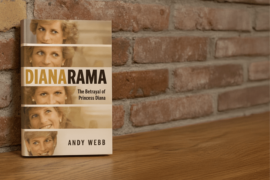
THERE are moments when an institution’s mask slips so completely that it can never truly be put back on. Former BBC journalist Andy Webb’s scorching book Dianarama, published last week, is such a moment for the BBC.
On top of the unfolding and escalating scandal about the Prescott dossier, which concludes that the BBC Board (and its predecessors, the Trustees and the Governors) were and are incapable and arguably unwilling to properly police accuracy, impartiality and good enough practice, Webb’s forensic reconstruction of the Martin Bashir scandal not only exposes his original deceit in 1995, but shatters the manufactured history the BBC has spent nearly 30 years carefully layering over it.
Now — true to form — it emerged this week that the BBC is already trying to rewrite the rewrite. The Corporation’s latest coverage of Webb’s book, posted in predictably defensive tones on its own website, would have you believe this is a story long resolved, its shame confessed, its wounds healed.
‘Lord Dyson established what happened,’ it insists, as if the BBC had been dragged kicking and screaming into truth-telling and is now eager to move on, chastened and cleansed. But this is merely the BBC’s latest falsehood in a saga of cover-up and deception going back to 1995. The crucial truth the BBC avoids mentioning — indeed, arguably the truth it relies on the public forgetting — is that Lord Dyson was never allowed to investigate the full scandal. The BBC engineered a narrow, tightly fenced brief that narrowly focused almost solely on then director of news Tony Hall’s botched internal investigation of 1996.
Dyson was barred from examining the BBC’s conduct in 1995, when the forged bank statements were deployed. He was barred from examining the BBC’s long-term behaviour between 1996 and 2020. He was barred from scrutinising destroyed records, vanished memos, suspicious archive gaps, and two decades of misleading press statements. The Corporation hired Dyson to examine a single chapter and now pretends he otherwise delivered a clean bill of health.
Webb, unrestrained by BBC lawyers or corporate boundaries, has produced the account Dyson could never have written. It is the missing autopsy report, the one the BBC hoped would never exist.
And what Dianarama reveals is devastating. Far from a lone reporter’s deception, the Bashir affair emerges as a multi-layered, multi-year conspiracy of silence. Forged bank statements which outrageously suggested that Diana could not trust the key figures in her household were merely the spark.
The real conflagration was the institutional response, one that involved BBC editors who doubted Bashir’s story but waved it through, multiple senior executives who saw red flags but closed their eyes and have never been held to account, an internal investigation designed not to uncover the truth but to bury it, and a senior leadership, including four director generals, who knowingly misled the public for 30 years.
Perhaps the most disturbing revelation is that the BBC’s cover-up did not age, weaken, or fray over time. It calcified. It broadened. It became part of the BBC’s DNA in how it handled complaints.
Files quietly disappeared. BBC lawyers stonewalled Freedom of Information requests. Press officers recycled denials they knew were untrue. Successive DGs inherited the lie and decided, consciously or not, to maintain it. The BBC did not merely fail Diana. It failed the British public, over and again, while insisting with astonishing arrogance that it is the guardian of national truth and journalistic integrity.
And now, as Webb forensically sets out the fuller, darker story the BBC suppressed, the Corporation has responded in the same way it always does: by belittling, minimising and reframing.
Its latest website piece seeks to cast Webb’s findings as curious ‘background’, interesting ‘detail’ and helpful ‘context’ to the supposedly authoritative Dyson report. This is not transparency. This is cynical, deceptive crisis management — the BBC’s attempt to contain Webb’s revelations before they infect the wider debate about its failed culture, its collapsed leadership, and its dangerous power.
This behaviour is not a relic of the 1990s. It is the BBC’s operating model today. The same culture that lied to Diana caused Panorama to broadcast a doctored Trump speech — and then hid that fact for six months.
The same managerial instincts that closed ranks around Bashir have also dictated the Corporation’s distorted Gaza coverage, its climate alarmism orthodoxy, its systematic smearing of mainstream opinion as ‘far-right’, and its treatment of legitimate public complaints as irritants to be neutralised.
The same BBC that deceived a vulnerable princess continues to deceive the nation under the comforting slogan of ‘impartiality’.
The Corporation claimed at the Department of Culture, Media and Sport select committee on Monday (called to look at the Prescott dossier) that its internal scrutiny processes would be reformed and that the Corporation was ready to introduce better accountability.
The truth is that an institution which still cannot tell the truth about its greatest scandal is not reformed; it is unreformable from within. BBC chairman Samir Shah’s testimony to the committee was yet more window-dressing and mealy-mouthed assurances. Committee chairman Carol Dinenage was right to claim on the Today programme on Tuesday that the BBC is not in safe hands.
Andy Webb has done what the BBC paid Lord Dyson not to do: he has shown the extent of the internal rot and lack of accountability. He has revealed the breadth of the complicity, the longevity of the cover-up, and the continued dishonesty of the Corporation’s public narrative. He has proved that the BBC is incapable of policing itself, incapable of honest self-reflection, and incapable of telling the truth when the truth threatens its power.
The Bashir affair did not end in 1996. It did not end in 2021 with the Dyson report. It will not end until Parliament ends the system that allowed it to happen: a broadcaster funded by compulsion, protected by statute, and permitted to investigate itself.
Diana deserved the truth. Britain deserves the truth. Andy Webb has now shown, beyond any reasonable doubt, that the BBC will never give it unless it is forced to.
